
The Crucifixion of Jesus: Roman Execution, Gospel Sayings & Christian Meaning
Gary WhittakerRighteous Roots · Act III · Passion Week
That Jesus was crucified under Pontius Pilate is one of the most widely accepted historical facts about his life. Christian claims about what the death accomplishes belong to the next evidence layer: theology.
Direct answer: What do we know historically about Jesus’ crucifixion?
Jesus was executed by Roman crucifixion under Pontius Pilate. The Gospel accounts preserve different details about the people crucified with him, his words from the cross and the surrounding events. Historians can establish the execution with high confidence; Christian claims about atonement, sacrifice, victory and reconciliation are theological interpretations of what that death means.
What crucifixion meant in the Roman world
Crucifixion was designed not only to kill but to humiliate, terrorize and publicly display Roman power. It was commonly associated with enslaved people, rebels and people viewed as threats to public order. That setting matters because it explains why the charge “King of the Jews” was politically dangerous.
Roman execution
Crucifixion was a Roman instrument of public humiliation, punishment and deterrence, especially associated with enslaved people, rebels and lower-status offenders. The inscription “King of the Jews” in the Gospel narratives frames the execution politically.
Read the historical background: Roman Crucifixion Before Jesus.
How the four Gospels frame the crucifixion
| Gospel | Distinctive emphasis |
|---|---|
| Mark | Abandonment, mockery, darkness and the centurion's response |
| Matthew | Builds on Mark with additional apocalyptic signs |
| Luke | Forgiveness, the repentant condemned man and trust in God |
| John | Jesus' mother and beloved disciple, thirst and “It is finished” |
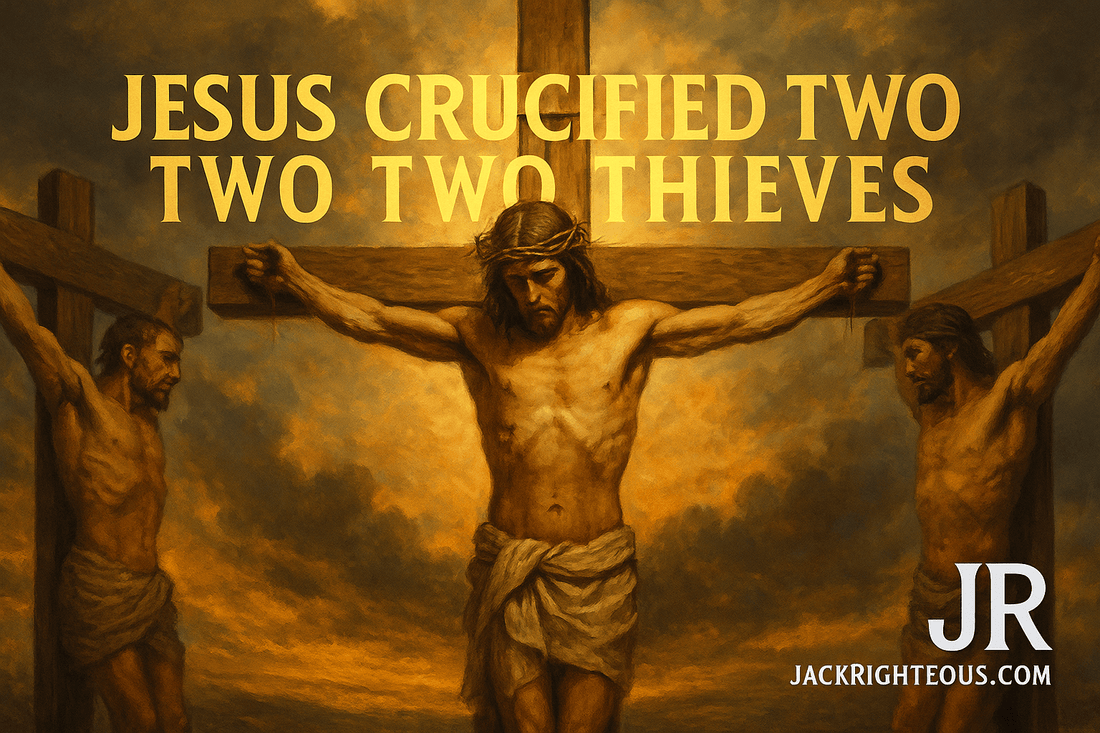
“Two thieves”?
Traditional English retellings often call the men crucified with Jesus “thieves.” The Gospel terminology is broader and varies. Luke uniquely develops one condemned man’s conversation with Jesus. The safest description is that Jesus was crucified between two other condemned men.
The sayings from the cross are distributed across sources
No single Gospel contains the traditional collection of seven sayings. Mark and Matthew preserve the cry of abandonment; Luke includes sayings of forgiveness, paradise and entrusting the spirit; John includes statements involving Jesus’ mother, thirst and completion. The “seven last words” are a later Christian harmonization of multiple Gospel witnesses.
The traditional seven last words are a harmonization
No single Gospel records all seven sayings traditionally preached as Jesus' “seven last words.” The collection is formed by combining sayings distributed across Matthew, Mark, Luke and John. That can be meaningful devotionally, but it should not be mistaken for one continuous transcript from a single ancient source.
What history can say confidently
- Jesus was crucified under Pontius Pilate.
- Crucifixion was a Roman form of execution.
- The execution carried political and public-shaming dimensions.
- Early Christian sources interpreted Jesus' death as central to his mission.
What moves into theology
- That Jesus' death atoned for sin.
- That it fulfilled a divine sacrificial plan.
- That the cross defeated spiritual powers.
- How different atonement images should be combined.
Christian interpretation
The New Testament interprets Jesus’ death through multiple images: sacrifice, covenant, reconciliation, victory, ransom, faithful obedience and more. Christian traditions continue to debate how those images relate. History can establish execution; theology asks what Christians believe God did through it.
Next step
What happens after Jesus dies?
The next question is burial, the empty tomb and how the earliest resurrection evidence develops from there.
Continue to The Resurrection of Jesus →
Compare Mary Magdalene & the Empty Tomb →
