
AI Music Success: Real Use Case from 'From Text to Track
Share
CREATOR CASE STUDY · ORIGINALLY PUBLISHED JANUARY 2025
This article preserves an early AI-music experiment involving my son, a sound engineer and musician. The Suno versions are historical, and the original article drew stronger conclusions from the result than I would today. What still matters is the workflow change: a skeptical professional tested the tool, kept his standards, and found a way to use AI selectively.
AI Music Success: Real Use Case from From Text to Track
The useful part of this story is not that AI “made a believer” out of a professional musician. It is that someone with real production experience moved from rejecting the tool to testing it on his own terms.
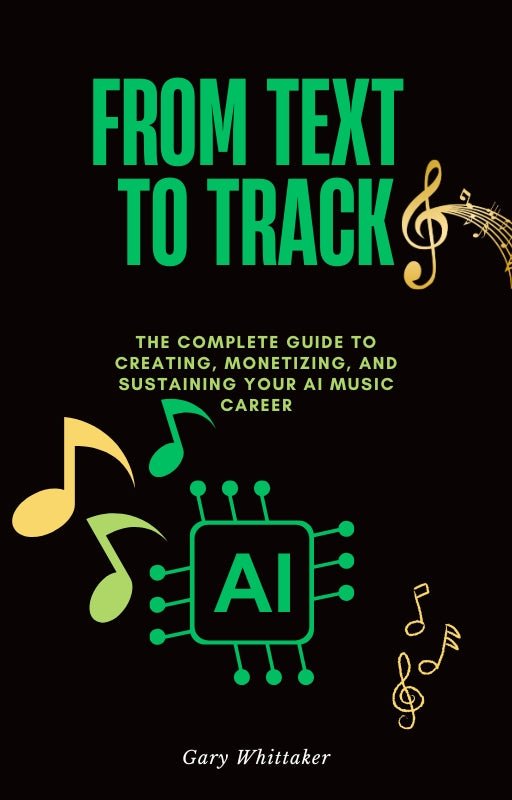
When I first published this in January 2025, I was also promoting my early book, From Text to Track: Mastering AI Music Creation, Monetization, and Growth. The article connected my son’s new release, the book’s prompting ideas, and an early streaming milestone a little too neatly. I am keeping the story, but separating what we observed from what we can actually claim caused the result.
The Starting Point: Skepticism
My son is a sound engineer and musician. During the Suno V3 era, he could see what AI music tools were capable of, but he did not want generated music inside his own projects. His concern was not ignorance of the technology. It was creative control.
He valued building music deliberately and wanted to know what part of the result was actually his. That is still a reasonable position—and an important one for any experienced creator considering AI.
What Changed in the V4 Era
When Suno V4 arrived, he decided the tool had become worth another test. That did not mean abandoning his standards or replacing his production knowledge. It meant opening his own account, experimenting directly, and judging the results himself.
His original Suno profile remains part of this case study: The Ghost That Makes Dubstep.
After years away from releasing a full project, he put out a new album using an AI-assisted workflow. That is the part of this story I still find significant: the technology helped make returning to the work practical enough to try.
The Reported Result
The original January 2025 article reported that the album reached 1,000 streams within three days.
I am preserving that number as it was reported at the time. I am not using it as proof that Suno, prompting, or From Text to Track caused the streams. A release result can be affected by the artist’s existing audience, promotion, timing, platform behavior, genre, relationships, and many other factors.
The better lesson is that there was a finished release to measure at all.
What Actually Changed the Workflow
A trained creator does not become valuable because an AI model gives them more outputs. Their advantage is knowing how to judge those outputs.
In this case, the useful shift looked more like this:
- Test instead of assume. He tried the newer tool rather than deciding from the earlier version alone.
- Keep a creative filter. Generated material still had to fit his taste, standards, and direction.
- Use experience to evaluate faster. Production knowledge made it easier to hear what worked and what did not.
- Treat AI as material, not authority. The tool could offer possibilities; the creator still decided what became part of the project.
- Finish something. The workflow helped move from experimentation to an actual release.
Where From Text to Track Fit
The original article said the book’s strategies were “instrumental in his success.” I would not make that causal claim now.
What I can say is that the book reflected the same ideas I was discussing with him at the time: clearer prompting, stronger creative direction, thinking about audience and presentation, and looking beyond generation toward release and business decisions.
Those ideas can support a creator. They cannot guarantee streams, licensing, sync placements, revenue, or a sustainable career.
View the original Amazon listing for From Text to Track
AI-Assisted Does Not Mean Creative Surrender
This is also a useful example of why I now separate AI-Generated, AI-Assisted, and Full Copyright as practical labels.
The important question is not whether AI touched the project. It is what the human creator actually directed, selected, changed, performed, arranged, edited, documented, and can prove.
A professional can use AI and still bring substantial judgment and authorship to a project. But the exact rights position depends on the specific contributions, source material, platform terms, and applicable law—not on the label alone.
The Operator Lesson
The process I teach now is:
INTENT → CREATE → SCORE → DECIDE → FIX → PACKAGE → PROTECT
This case study sits right in the middle of that sequence. Suno helped with creation. His experience mattered most at SCORE and DECIDE: deciding what was usable, what needed work, and what deserved to become a release.
Listen to the Project
I am preserving the original project links so the article remains a genuine case study rather than a rewritten abstraction:
What Still Holds Up
- Experienced musicians do not need to become less skilled to use AI.
- Skepticism can be useful when it forces you to test a tool against real standards.
- A newer model may change whether a tool fits your workflow, but it should not replace your creative judgment.
- Prompts are inputs, not guarantees.
- A release is more than generation: it still requires decisions about editing, packaging, rights, distribution, and audience.
- The best evidence is not hype around the tool. It is what the creator can actually finish, explain, and improve.
Your next best step
If you are deciding how AI should fit into your own production process, start with the broader AI Music & Audio system. If Suno is already the tool you want to test, use the current Suno Hub for V6-specific guidance rather than treating this V3/V4-era case study as a platform manual.
Gary Whittaker
Founder and Operator, JackRighteous.com
