
KI-Musikdistribution: Plattformen & Strategieführer
Where Can You Sell AI Music in 2026? Direct Sales, Streaming, Licensing & Client Work
The central free 2026 Jack Righteous guide to where AI music creators can sell and monetize their work. Choose a revenue route, check restrictions and rights, then continue into MONETIZE Stage 6 to build the model, offer, pricing,...
Free JR Core Hub · Sell & Monetize AI Music
Where Can You Sell AI Music in 2026?
Start with what you want to sell—not with a platform name. This free guide helps you choose among direct sales, streaming, licensing, custom client work, YouTube/social monetization and creator products, while avoiding routes that currently reject substantially AI-generated music.
Choose Your Revenue RouteBuild the Paid MONETIZE SystemUpdated August 21, 2026
The short answer
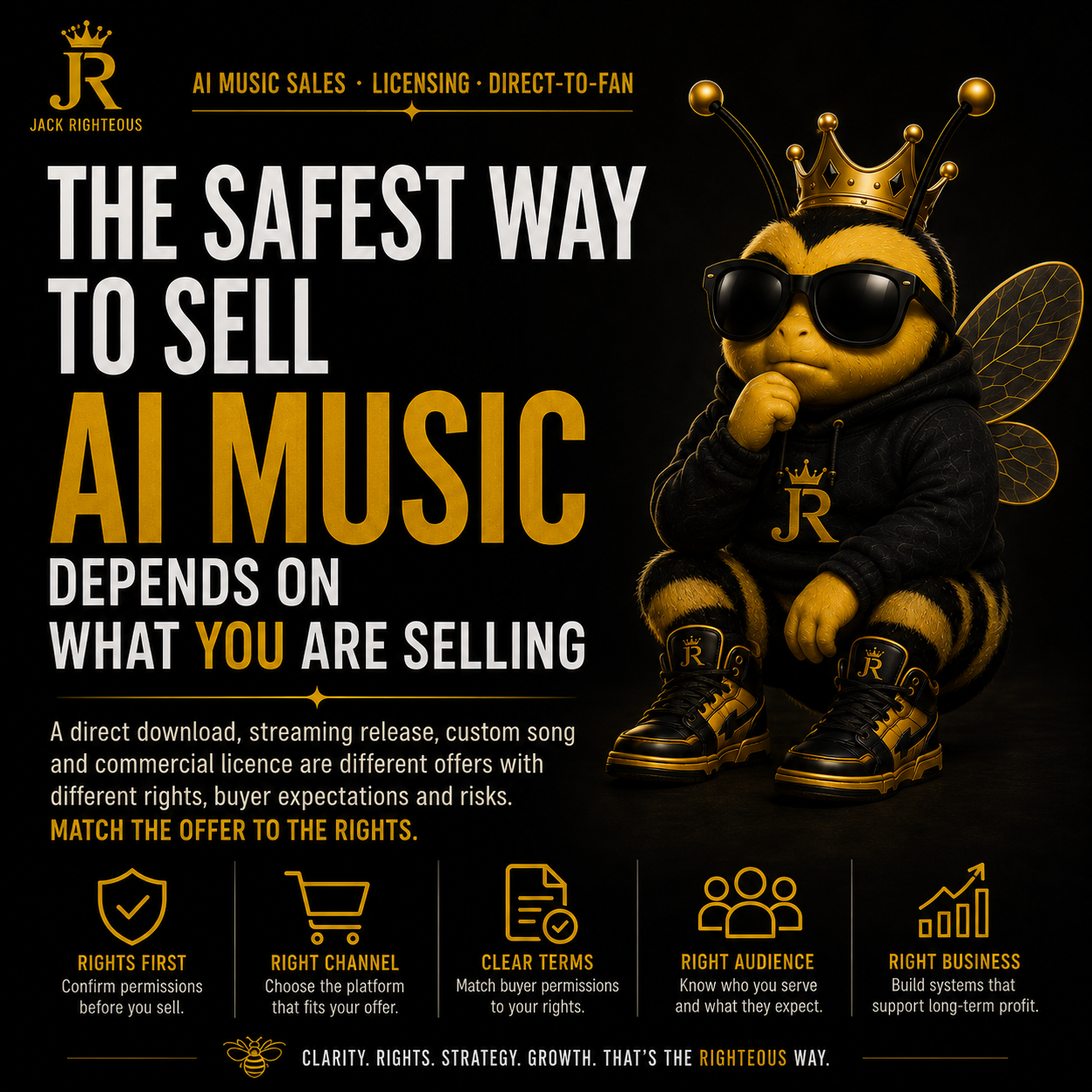
AI music can be sold and monetized in multiple ways, but there is no single platform that fits every creator or every AI-created track. The right route depends on the rights you have, what the buyer receives, how the music was created, and the rules of the service handling the transaction or release.
This page answers where and how you could monetize. The paid MONETIZE Your Sound stage begins after that decision and builds the buyer, value exchange, offer, price, conversion path, fulfilment system and commercial evidence needed to test whether the idea actually works.
Choose the money path before the platform
Direct-to-fan
Sell a recording, bundle or supporter product
Best when people already want to support your work. An owned storefront gives you control over the offer, customer relationship and licence language.
See direct-sales routeStreaming
Release to Spotify, Apple Music and other DSPs
Best for catalogue building and audience reach. You normally need a distributor, and both distributor rules and destination-platform rules matter.
See streaming routeLicensing
Let businesses or creators use your music
Best when your rights records are organized and you can define exactly what the client may do with the asset.
See licensing routeClient work
Create custom songs, themes and audio from a brief
Often a stronger early revenue route than chasing streams because one qualified client can be worth more than a large number of plays.
See client-work routeAudience monetization
Use music inside YouTube and social content
Revenue may come from channel monetization, sponsors, affiliates, products and services. Content ID is a separate rights-management question.
See audience routeCreator commerce
Sell products or services around your music
Your most defensible product may be your process, expertise, resource or service rather than the generated audio alone.
See creator-commerce routeYou can choose a route here for free. The harder part comes next.
Once you know which route fits, the commercial questions change: Who is the buyer? What exactly are they paying for? What can you responsibly promise? What should it cost? How does interest become payment and delivery? What evidence tells you to keep going?
That is the purpose of MONETIZE Your Sound — Stage 6. Paid members work through MODEL → OFFER → CONVERT → PROVE with eight workshops, six implementation tools and an advanced Route-to-Offer guide.
See What MONETIZE Builds1. Sell AI music direct-to-fan
An owned website can be the strongest long-term base for downloads, supporter bundles, limited releases, memberships or commercial-use upgrades because you control the product description, checkout, customer record and licence language.
Strong fit: Shopify or another owned storefront where the buyer can clearly see what they receive and what they are permitted to do with it.
A download should state whether it is personal-use only or includes commercial rights. Paying for a file does not automatically transfer copyright, exclusivity or broad commercial permission.
2. Release AI music to Spotify, Apple Music and other streaming services
Streaming is a distribution route, not a direct-sale storefront. You normally submit through a distributor that delivers eligible releases to destination services.
| Question | What to check |
|---|---|
| Will the distributor accept this release? | AI-content policy, rights requirements, impersonation rules, spam rules and disclosure. |
| Will the destination service accept it? | Spotify, Apple Music, YouTube Music and other services can apply their own policies after delivery. |
| Can you monetize it? | Commercial-use permission from the creation tool plus cleared outside material and compliant metadata. |
| Is streaming the business model? | Decide whether streams are the revenue endpoint or mainly a discovery mechanism feeding another offer. |
Use the AI Music Distribution Rules 2026 before choosing a distributor. If using DistroKid for Spotify, continue to the Spotify + DistroKid guide.
3. License AI music for videos, podcasts, games, ads and other projects
Licensing can create more value per track than streaming, but only when you can explain what rights you are granting. A useful licence defines the project, media, territory, duration, editing rights, paid advertising, attribution, exclusivity, sublicensing and renewal.
Do not promise exclusivity if generated elements, samples, voices, collaborators or platform terms do not support that promise.
Continue with the AI Music Contracts and Licensing Toolkit.
4. Sell custom AI-assisted music and client work
Custom songs, podcast themes, intros, creator themes, event music and commissioned audio can be practical revenue routes because the customer pays for a defined outcome rather than platform discovery.
Your agreement should cover the brief, delivery date, revision limit, file formats, ownership or licence, AI disclosure, client-supplied material, cancellation, refunds and whether you may reuse the work in a portfolio.
Important distinction: permission to commercially use an AI tool does not automatically mean you can transfer exclusive ownership of everything it generated.
5. Monetize AI music through YouTube and social content
You can build revenue around music through video-channel monetization, sponsors, affiliate links, products, services and memberships. That is different from registering a recording in Content ID.
Commercial-use permission alone does not make a recording eligible for automated rights claiming. Continue to Can You Monetize AI Music on YouTube in 2026?.
6. Sell products and services around your AI music
The generated track does not have to be the only thing you monetize. Creators can sell project reviews, consultations, release planning, training, templates, workflow systems, educational products, artwork bundles and other original assets they have the right to sell.
This route is particularly useful when your strongest asset is your process, audience knowledge or ability to help another creator finish a project.
For owned-store strategy, see Shopify for Creators.
7. Know where substantially AI-generated music is restricted
Bandcamp: its 2026 policy says music or audio generated wholly or in substantial part by AI is not permitted. Do not treat Bandcamp as a normal sales route for substantially generated Suno/Udio-style recordings. See the Bandcamp AI Music Ban guide.
CD Baby: CD Baby says it does not accept AI-generated content, including recordings where only part of the content is AI-generated, even when that material is commercially licensed. See the current distribution rules matrix.
Do not confuse AI-assisted production with every form of generated content. Mixing, mastering, cleanup, pitch correction or workflow assistance may be treated differently from a recording generated substantially by an AI music system.
Before accepting money, check five layers
- Creation-tool permission: does your plan allow commercial use of this output?
- Outside material: are uploaded audio, samples, lyrics, voices, covers and collaborator contributions cleared?
- Platform eligibility: does the distributor, marketplace or monetization service accept this type of AI content?
- Buyer promise: are you selling access, personal use, commercial use, exclusivity or an assignment?
- Records: can you connect the song, creation date, plan, source files, contributors and licence terms to the transaction?
If you are not sure where to start, use the AI Music Release Router, then the Before You Distribute AI Music checklist.
Where should you sell? Use this decision table
| Your goal | Best starting route | Next free authority |
|---|---|---|
| Sell downloads to supporters | Owned storefront / direct-to-fan | Rights & Monetization |
| Get music onto Spotify/Apple | AI-compatible distributor | Distribution Rules |
| License music to businesses or creators | Direct licensing / licensing-ready catalogue | Contracts & Licensing |
| Create music for clients | Custom service agreement | Rights & Ownership |
| Earn through videos | YouTube/social audience monetization | YouTube Monetization |
| Build a creator business | Owned site + email + products/services | Shopify for Creators |
Ready to move from “where can I sell?” to “what should I build?”
MONETIZE Your Sound is the paid implementation stage. It does not give you another list of income ideas. It makes you choose one model, define one offer, set the commercial boundaries and pricing logic, build the path to payment and fulfilment, and collect evidence before deciding whether to scale it.
Enter the MONETIZE PathCheck Current Platform RulesFrequently asked questions
Where can I sell AI-generated music in 2026?
Depending on your rights and workflow, possible routes include an owned direct-to-fan store, AI-compatible music distributors, direct licensing, custom client work, YouTube/social monetization and creator products or services.
Can I sell Suno music?
Potentially, when the specific song has commercial-use permission under the applicable Suno terms and all outside material is authorized. Distributor and destination-platform rules still apply.
Can I sell substantially AI-generated music on Bandcamp?
No. Bandcamp's current policy says music or audio generated wholly or in substantial part by AI is not permitted.
Does CD Baby accept AI-generated music?
CD Baby currently says it does not accept AI-generated content, including recordings containing only partial AI-generated content, even when commercially licensed.
Is streaming the best way to make money from AI music?
Not necessarily. Streaming offers broad availability but usually requires significant audience volume. Direct sales, licensing and custom client work can produce more value per customer.
What does the paid MONETIZE stage add?
It turns a chosen revenue route into a commercial system: buyer and value hypothesis, rights boundaries, offer, scope, pricing or quote logic, promotion test, conversion, payment, fulfilment, economics and an evidence-backed next decision.
JR support boundary
Jack Righteous provides creator education, workflow guidance and project-planning support. Platform rules can change, and this guide does not guarantee ownership, copyright, distributor acceptance, marketplace acceptance, Content ID eligibility, royalties, licensing success or profitability.
Prepare the release
A release should be supported by proof, not guesswork.
Organize the song, rights record, presentation and first audience pathway before you distribute.

Discussion