
AI Music Distribution: Platforms & Strategy Guide
How I Would Use SoundCloud for AI Music in 2026: Lessons From 100K Plays
A 2026 SoundCloud strategy for AI-assisted artists built from Jack Righteous's 100K-play experiment: fewer stronger uploads, private feedback, Follower Exclusive demos, scheduled releases and intentional fan development.
Originally published August 6, 2024 · Rebuilt August 17, 2026
I once uploaded more than 400 tracks to SoundCloud, reached more than 100,000 plays and learned something I would not recommend repeating: volume can create activity without creating a strong artist relationship. If I were building with SoundCloud again in 2026, I would use it far more deliberately—as a place to test music, gather feedback and give followers a reason to stay close to the project.
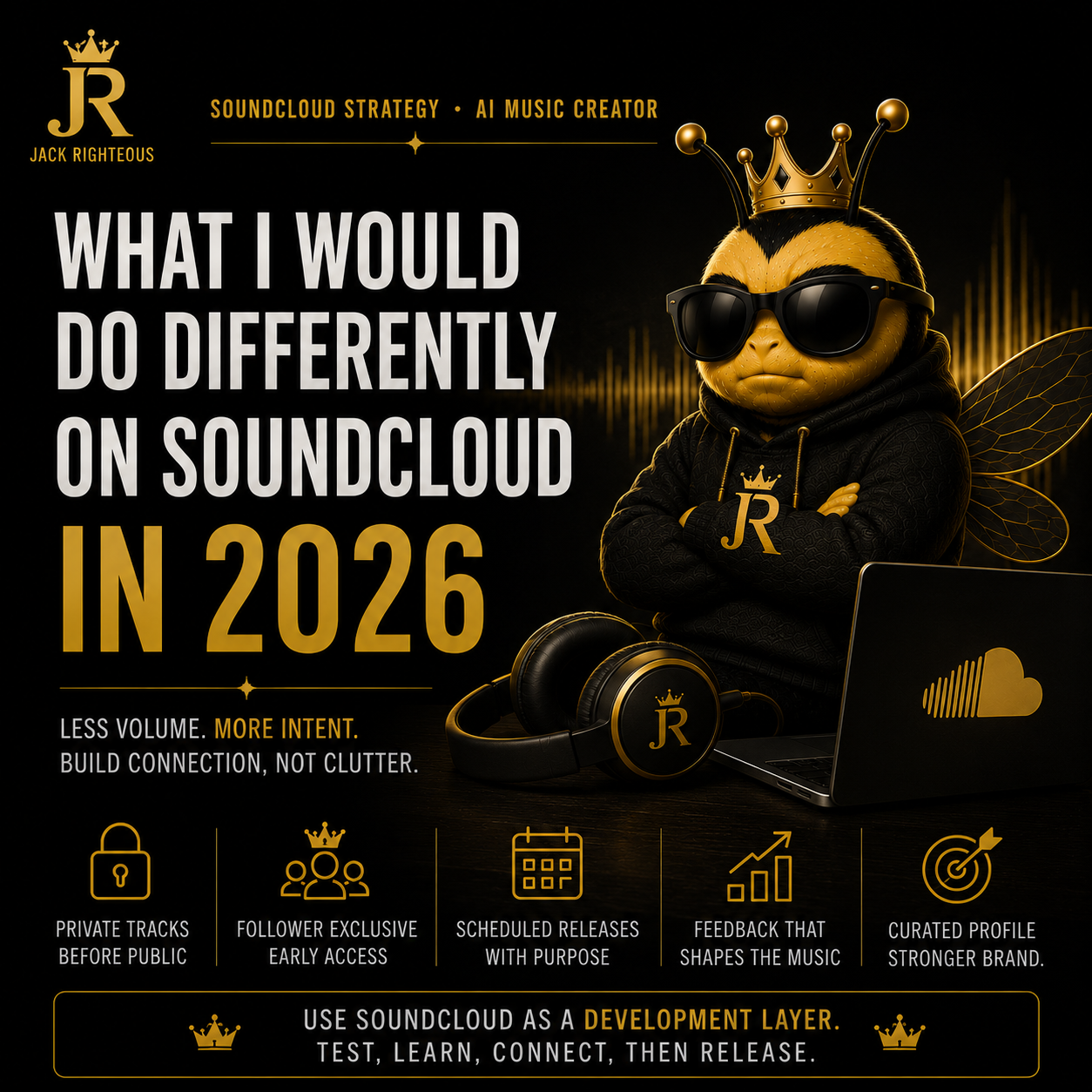
Jack's 2026 answer: I would not use SoundCloud as a dumping ground for every AI-generated idea. I would use it as a development layer between creation and release: private test → follower-exclusive version → stronger public release → wider campaign when the song earns it.
What my 100K-play SoundCloud experiment actually taught me
In 2024 I treated AI music creation almost like a full-time production line. I released constantly, uploaded hundreds of tracks and experimented aggressively. That helped produce more than 100,000 plays and more than 70 followers from a standing start.
The raw numbers looked encouraging. The deeper lesson was more useful: attention and connection are not the same thing.
I could create many songs quickly, but a high-volume profile made it harder for individual songs to feel important. I eventually removed roughly half of what I had uploaded, especially weak tracks, duplicate versions and songs that had generated little response.
The lesson I would keep: AI gives you permission to experiment cheaply. It does not require you to publish every experiment.
What I would do differently on SoundCloud in 2026
My strategy now would be built around fewer public releases and more controlled testing. SoundCloud has become more useful for that workflow because creators can keep tracks private, schedule releases, replace eligible audio files without losing existing engagement, and—on Artist Pro—publish tracks specifically for followers before making them public.
| 2024 approach | What I would do in 2026 |
|---|---|
| Upload almost everything | Keep experiments private until they earn a public slot |
| Daily or near-daily public releases | Give stronger songs enough time to collect meaningful feedback |
| Several versions competing on the profile | Test versions privately and publish the strongest one |
| Use plays as the main signal | Watch comments, repeat listeners, followers and direct feedback |
| Treat SoundCloud mainly as another release destination | Use it as an artist-development and fan-feedback layer |
1. Use private tracks before deciding what deserves a public release
SoundCloud private tracks do not appear on your public profile and are not searchable, but they can be shared through private links. That makes them useful for collaborators, trusted listeners or a small feedback group before you commit a song to your public catalogue.
For an AI-assisted creator, this solves a real problem: generation makes version creation easy. Public release decisions should still be selective.
I would use private links to answer specific questions rather than asking “Do you like it?” For example: does the chorus arrive quickly enough? Which vocal version feels more believable? Does the second verse lose energy? Would you listen again?
If the song changes after feedback, SoundCloud currently allows Artist and Artist Pro subscribers to replace the audio file on eligible non-monetizing tracks without losing the track's existing stats or comments. That creates a useful iterative workflow when the feature applies.
2. Use Follower Exclusive releases to make a SoundCloud follow worth something
SoundCloud's Follower Exclusive Releases are a materially different opportunity from the platform I was using in 2024. Artist Pro subscribers can now make a track available only to followers. Non-followers can see that the track exists, but they are prompted to follow the artist to unlock it.
SoundCloud specifically suggests using the feature for early releases, demos, works in progress and exclusive content. A creator can later switch the track back to public.
Important limitation: SoundCloud says Follower Exclusive works only with tracks uploaded directly to SoundCloud—not tracks delivered to SoundCloud through a distributor or label supply chain.
That limitation actually makes the strategic role clearer. I would not use Follower Exclusive for every finished distributor-delivered release. I would use it for the material around the release: an early mix, an alternate version, a demo, a pre-release preview or a work-in-progress that gives followers access they cannot get from Spotify.
A simple follower-exclusive campaign
I would upload a promising song directly to SoundCloud as Follower Exclusive, share the track link on social media, and explain that following on SoundCloud unlocks the early version. After collecting reactions, I could refine the release and later make the SoundCloud track public or launch the finished master through the wider release campaign.
The point is not to manufacture scarcity. It is to create a legitimate reason for someone who already likes the work to stay closer to the process.
3. Use scheduled releases when timing matters
Artist Pro also allows private tracks to be scheduled to become public at a specific date and time. I would use this for planned public drops instead of manually publishing whenever the file happens to be ready.
This is especially useful when a SoundCloud public release needs to align with a video premiere, social campaign, newsletter or another moment where the song has supporting attention around it.
Scheduling does not make the release important by itself. It simply lets the creator decide when the attention window begins.
4. Keep the public profile curated
My 2024 spring cleaning was one of the strongest decisions I made. I removed weak versions and tracks that no longer represented what I wanted the profile to say.
I would be even stricter now. Someone discovering your profile does not need to see every generation that led to the final song. They need enough strong material to understand what kind of creator or artist they have found.
A useful rule: experiments can be abundant behind the scenes. The public catalogue should feel intentional.
Use playlists to group tracks by project, mood, era or release purpose. Keep the profile image, banner, bio and external links current. If a visitor likes one song, make the next good thing easy to find.
5. Turn reactions into creative decisions—not just vanity metrics
One of the most useful parts of my early SoundCloud experiment was learning that my own favorite song was not always the one listeners responded to most strongly.
That is useful information when interpreted carefully. A play can come from curiosity. A thoughtful comment, repeated listening, a follow or someone asking when the finished version is coming can tell you more about whether a track is building a relationship.
Artist Pro's current Insights and fan tools can surface top listeners and other audience information. I would use that information to identify songs worth developing further and people worth engaging with—not as a reason to chase every small fluctuation in analytics.
6. Keep SoundCloud distribution and monetization policy in a separate lane
My original 2024 article spent significant space on my inability to get AI-generated releases accepted into SoundCloud's distribution system. That issue deserves its own current guide because SoundCloud's AI eligibility rules have become much more explicit.
If your question is specifically “Can I monetize or distribute my Suno song through SoundCloud for Artists?”, use the updated Rejected by SoundCloud: Lessons for AI Music Creators. That article now tracks the approved AI partner list, Suno eligibility and documentation requirements.
If your question is whether the paid SoundCloud subscription itself is worthwhile, use Is SoundCloud Artist Pro Worth It for AI Music Creators in 2026?. This page is deliberately about strategy, not another pricing or policy review.
The SoundCloud workflow I would use now
| Stage | SoundCloud role | Decision |
|---|---|---|
| 1. Generate and develop | Keep multiple experiments off the public profile | Which version has enough potential to test? |
| 2. Private test | Share a private link with selected listeners | What specifically needs improvement? |
| 3. Refine | Replace eligible audio or upload the stronger version | Did the change actually improve the song? |
| 4. Follower preview | Use Follower Exclusive when it suits the project | Does the song create enough interest to justify a larger release? |
| 5. Public release | Schedule or publish intentionally | What campaign or story supports this song? |
| 6. Review | Study comments, listeners, follows and repeat response | Develop further, promote wider or move on? |
This workflow changes SoundCloud from a storage shelf into a useful decision-making environment. That is much closer to how I would teach an AI-assisted creator to use the platform today.
Frequently asked questions
Should AI music creators upload every song they generate to SoundCloud?
I would not. Generation volume is useful for experimentation, but public volume can bury your strongest work. Use private testing and publish selectively.
What is a SoundCloud Follower Exclusive release?
It is an Artist Pro privacy option that allows followers to hear a track while non-followers are prompted to follow to unlock it. SoundCloud positions it for early releases, demos, works in progress and exclusive material.
Can I make a distributor-delivered track Follower Exclusive?
SoundCloud says the feature only works with tracks uploaded directly to SoundCloud, not tracks supplied through a distributor or label.
Can I make a Follower Exclusive track public later?
Yes. SoundCloud says the privacy setting can later be changed back to public.
Can I schedule SoundCloud releases?
Artist Pro creators can schedule a private track to become public at a chosen time. SoundCloud currently says scheduling is for individual tracks, not albums or playlists.
Can I replace a SoundCloud track after receiving feedback?
Artist and Artist Pro subscribers can replace the audio file on eligible tracks without losing stats or comments. SoundCloud notes that the replacement feature cannot be used on a track already monetizing through SoundCloud for Artists.
Is SoundCloud a good place to test an AI-assisted song before Spotify?
It can be, particularly through private links and controlled follower previews. Treat the feedback as one input into the release decision rather than assuming SoundCloud performance will predict every other platform.
Do not publish faster just because AI lets you create faster
The stronger advantage is being able to make more versions, compare them and release the one you actually want people to remember.
Build the Song Through Find Your SoundCheck SoundCloud AI Eligibility
Official SoundCloud sources
- Follower Exclusive Releases
- Edit Your Track's Privacy Settings
- Schedule a Release Date
- Artist Pro: Features and Benefits
- Replace a Track's Audio File
Last reviewed against SoundCloud's current public creator guidance on August 17, 2026.
Prepare the release
A release should be supported by proof, not guesswork.
Organize the song, rights record, presentation and first audience pathway before you distribute.

Discussion