Jack Righteous Resource Guide
Know what you’re getting before you begin.
See who this resource is for, how access works, and what happens after checkout.
Access
Free resource
Best for
Creators who want focused guidance for this stage of their work.
What happens next
Access instructions are provided after checkout.


Jack Righteous
Free AI Music Rights Record — Label Edition | Fillable PDF
Free AI Music Rights Record — Label Edition | Fillable PDF
Impossible de charger la disponibilité du service de retrait
Jack Righteous / Free creator resource / Label Edition
Know the rights position behind your next release.
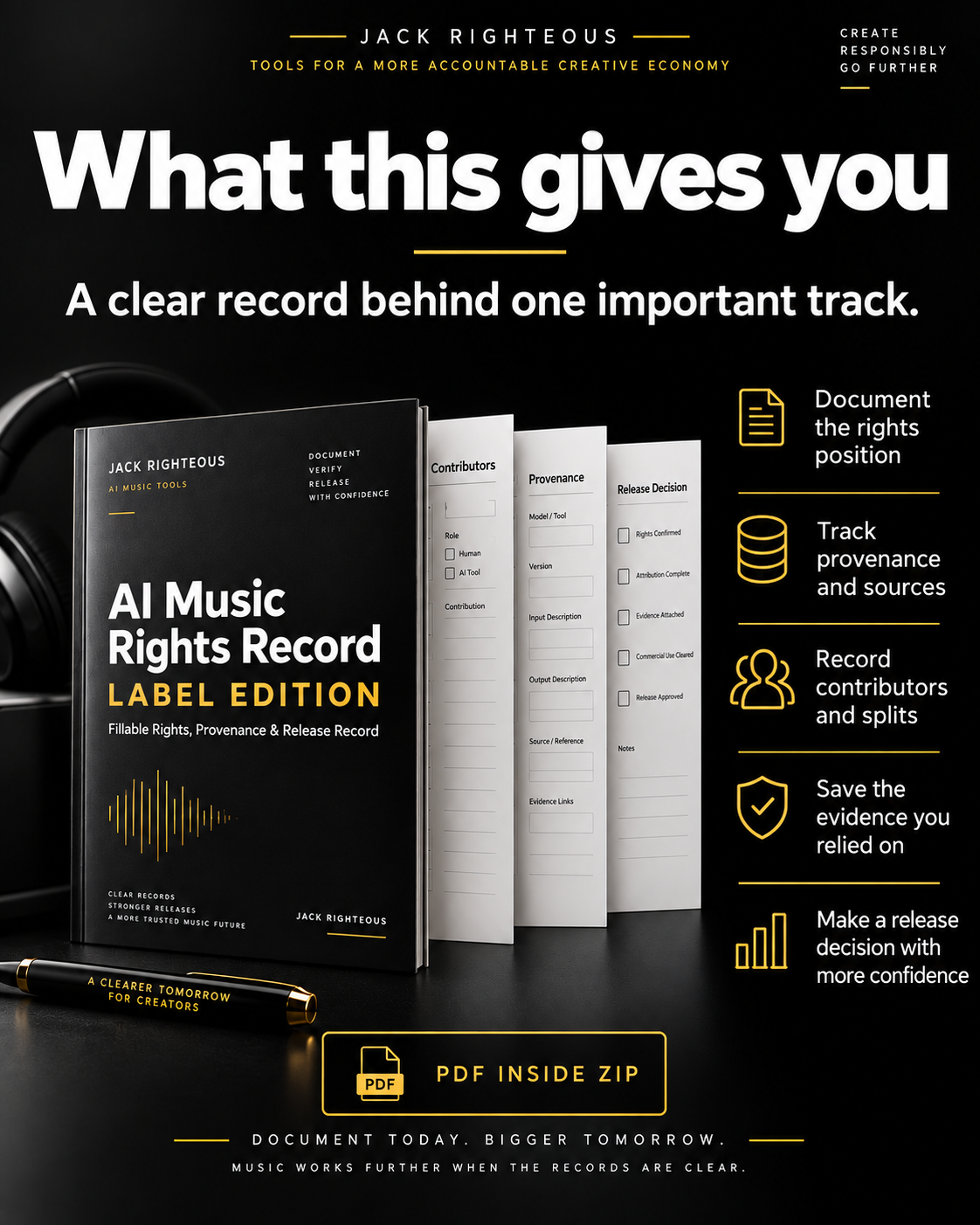
An updated 21-page fillable rights workbook for one AI music track when contributors, source material, licences, client requests or commercial use deserve careful documentation. Organize what you know, identify what needs checking and record the decision you can actually support.
The practical outcome
A record you can explain.
Not a guess you have to defend.
Complete one evidence-based review for a particular track, version, intended use and date. See which permissions are documented, which conditions still apply, and which questions should hold up the planned use.
The record is useful for preparing a release or discussion with a collaborator, distributor, client or rights professional. It is not a copyright certificate or legal clearance.
A clear way to start
Four decisions. One usable record.
Identify the exact version, who is reviewing it, and what they want to do.
Record licences, source material, contributions and relevant terms.
Identify conditions, exceptions, missing approval and blockers.
Proceed, proceed with conditions, hold, or do not proceed as planned.
What the PDF covers
Five separate rights questions.
A platform's commercial-use permission does not automatically establish copyright ownership, third-party clearance or a distributor's acceptance.
Model, plan, generation date, terms and use limits.
Your creative contribution and the copyright position being claimed.
Samples, uploads, split agreements, permissions and provenance.
Real-person identity, voices, consent and representation concerns.
Distribution, licensing, client delivery, Content ID and transfer limits.
Also included: evidence index, provenance ledger, contributor record, warranties and restrictions, release sign-off, catalog/repeat-use record, and review history.
Updated October 2026 / Edition 2.0
A clearer path from evidence to the next decision.
Edition 2.0 retains the five-layer Label Edition review and adds current creator-rights teaching, a worked example and source-verification checkpoints. 21 pages · 317 fillable fields · clickable contents and PDF navigation.
Distinguish AI-generated, AI-assisted and documented human-authorship workflows. These are JR documentation labels, not legal determinations.
Record the creation plan, remix origin, download status, terms relied on and supporting evidence for the intended use.
Keep AI involvement declarations separate from copyright, commercial permissions, and downstream platform acceptance.
See how a creator documents unresolved evidence and knows when the track needs another current-rules check.
Platform terms may change. Before acting on a rights position, check AI Rights Watch and the official rules for your actual tool, plan, creation date and proposed use.
Download and use
One fillable PDF. No ZIP to unpack.
Free (C$0). After completing the free checkout, download the AI Music Rights Record — Label Edition 2.0 PDF directly. Open it in a PDF reader that supports fillable forms, save a copy, and complete it for one track/version and one intended use.
Keep the finished copy together with your source files, terms, contributor agreements and supporting evidence. A filled PDF cannot replace the underlying documents or a professional opinion where one is needed.
Your next best step
Choose the resource for the question you actually have.
New to AI music rights? Read the free Rights & Ownership beginner lessons →
Need to log your own creative contribution? Free Creator Tracker — Human Work →
Unsure whether current rules have changed? AI Rights Watch → or Commercial Rights Report →
Addressed your rights questions and ready to plan a release? AI Music Release Support →
Need a more complete creation-and-release evidence file? The separate AI Music Proof Record is a paid, optional workbook covering creation history and documentation for an important release. It is different from this free rights-position review and is not required to complete it.
For educational recordkeeping only. This workbook does not certify rights, authorize use, guarantee registration or substitute for legal advice. Verify applicable terms and laws for the precise work and intended use.
↑ Back to top