
Campaign Page Strategy for AI Music Creators in 2026: Build an Owned Release Home
Gary WhittakerUPDATED FOR 2026 · FIND YOUR BRAND
Your Release Needs a Home, Not Just Another Post.
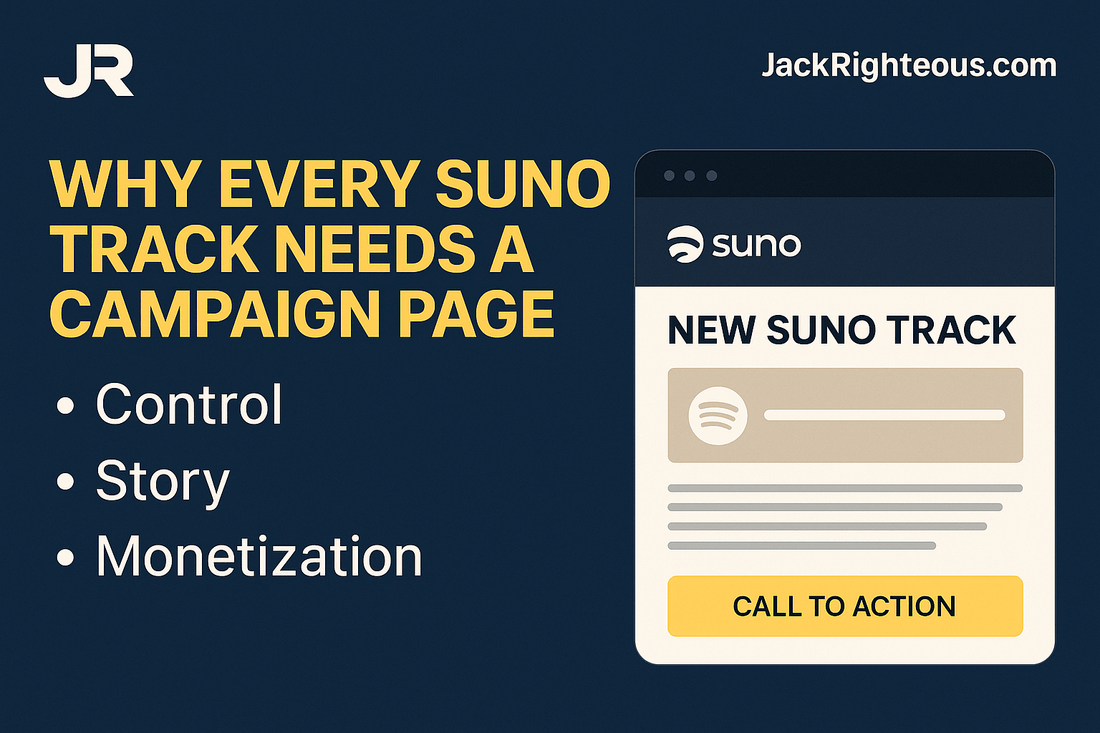
A campaign page is an owned destination for a song, release, creative project or focused creator campaign. Social platforms can introduce the work. Your campaign page carries the story, context, proof and next action after the post disappears from the feed.
This applies whether the music was created with Suno, Udio, Musicfy, another AI music tool, traditional production, or a combination of methods. The tool is not the strategy. The campaign page is the controlled destination.
TikTok, Instagram, YouTube, streaming platforms and other social surfaces help people encounter the work.
A bio link or Linktree can quickly split visitors toward a few destinations when several actions matter.
Your campaign page explains why the work matters and gives the visitor enough context to act.
Your domain can keep accumulating search value, email relationships, related content and future campaign updates after the social moment passes.
What a campaign page actually does
A campaign page is not a copy of your social profile and it is not a page where you dump every link you have. It is a focused destination built around one meaningful project or release.
Give the work context
Explain the song, project, creative decision, challenge or story in enough detail that a new visitor can understand why it exists.
Centralize the important assets
Bring together the music, video, artwork, lyrics or selected behind-the-scenes material instead of forcing the visitor to search across several platforms.
Choose the next action
Decide what matters most for this campaign: listen, watch, join the list, follow the project, read the story, download a resource, enter a challenge, or move to a relevant offer.
Create a durable URL
Use one destination that can be linked from social posts, newsletters, interviews, QR codes, collaborations and future articles without rebuilding the campaign every time.
LINKTREE VS CAMPAIGN PAGE
A router and a release home solve different problems.
Linktree is useful when the visitor needs a fast choice between several destinations. A campaign page is useful when one project needs story, media, search value, proof and a focused conversion path.
For a new creator with no site, a router can be a practical first step. For a creator building an owned system, the campaign page is where deeper campaign value should accumulate.
The campaign page minimum
| Element | Job | Keep it focused |
|---|---|---|
| Headline | Identify the release or campaign immediately. | Use the project name plus the reason to care. |
| Music or video | Let the visitor experience the work without hunting for it. | Feature the primary asset first; secondary embeds are optional. |
| Visual identity | Make the campaign recognizable across posts and destinations. | Use consistent cover art, type and campaign imagery. |
| Short story | Explain the idea, process or meaning. | Use enough context to create understanding, not a biography of everything you have made. |
| Primary CTA | Move the visitor to the next useful action. | One primary action should be visually obvious. |
| Optional proof or depth | Support visitors who want more. | Add lyrics, credits, behind-the-scenes material, press, process notes or related content only when it helps the campaign. |
Build around the visitor's intent
Listener campaign
Release story → featured track/video → streaming choices → follow or join the list.
Creator-learning campaign
Creative experiment → process breakdown → related free resource → relevant Find Your Sound, Voice or Brand path.
Challenge or participation campaign
Clear premise → example → instructions → submission or participation route → follow-up.
Commercial or service campaign
Specific problem → proof or example → explanation of the solution → booking, intake or product action.
Stage 1 practice example: Hype Your Hometown
The Hype Your Hometown practice sprint is a useful example because the page is not simply a link to a song. It gives the project a defined premise and participation structure. That is the campaign-page principle: the visitor should understand what is happening and what to do next without needing the original social post for context.
A campaign page can evolve as the project evolves. Add results, stronger examples, related content or a new CTA when the campaign moves into another phase. The durable URL stays useful while the campaign develops.
You do not need to build every idea into a campaign.
Not every AI music generation deserves a landing page. Build around the tracks, projects, experiments or offers that you are willing to support with additional attention.
Start with the smallest version that solves the visitor's problem. A title, embedded asset, short story and clear next action can be enough. Add complexity only when the campaign proves it needs more.
What to measure
A campaign page should tell you more than whether a social post received views. Track the handoff from discovery into your owned system.
Arrival
Which platforms, posts, newsletters or collaborators are sending useful traffic?
Engagement
Are visitors staying long enough to experience the featured media or read the core story?
Action
Are they taking the intended next step: streaming, joining, downloading, entering, booking or buying?
Continuation
Do visitors return, join your email/community, explore related content or move into another relevant creator path?
Common campaign-page mistakes
- Sending everyone to a generic homepage with no campaign context.
- Trying to display the full catalog instead of one focused project.
- Using several equally loud calls to action.
- Building the page around the AI tool instead of the audience or project.
- Embedding media without explaining why the visitor should care.
- Treating the page as finished forever instead of improving it when the campaign produces evidence.
- Depending entirely on rented platforms for the story, audience relationship and conversion path.
Where this sits in Find Your Brand
A campaign page is one practical expression of the owned home, rented distribution principle. TikTok, Instagram, YouTube and streaming platforms can create discovery. Your domain gives important work a place to remain understandable and useful after the feed moves on.
This does not mean every campaign must begin with a sophisticated website. It means the creator should understand what is rented, what is owned, and which layer is responsible for each job.
NEXT BEST STEPS
Build one useful campaign route before adding more infrastructure.
If you are still building your creator foundation, start with the free creator path. If you already have a release or participation idea worth supporting, use the Hype Your Hometown Stage 1 practice sprint as a working example of how a focused page can carry a project.
Start Here · Free Creator LabsSee the Stage 1 Practice SprintThe Righteous Beat
Bottom line
Social posts are excellent at creating moments. A campaign page turns the right moments into a destination you can keep improving.
Use rented platforms for discovery. Route people intentionally. Give meaningful work an owned home. Make the next action clear. Then measure whether the campaign is actually creating a deeper relationship.
