
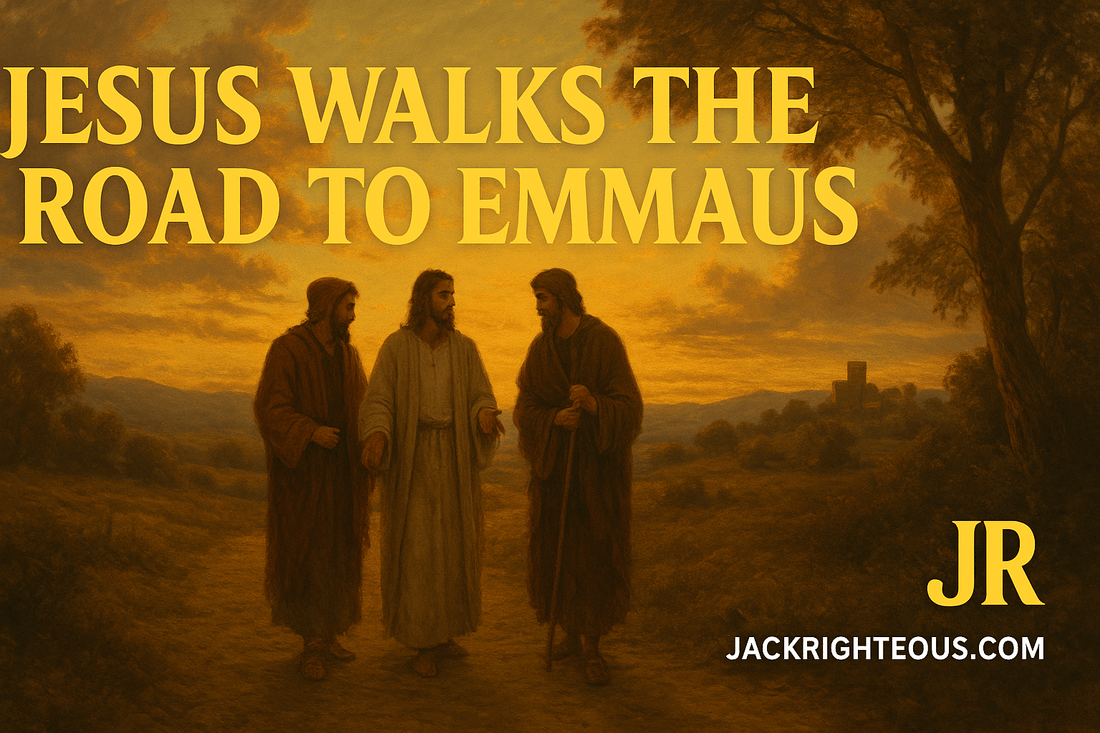
The Road to Emmaus: Luke’s Resurrection Story of Scripture, Recognition & Bread
Gary WhittakerRighteous Roots · Act III · Resurrection
The Emmaus narrative is one of Christianity’s most beloved resurrection stories—and it belongs specifically to Luke.
Direct answer: What happens on the Road to Emmaus?
In Luke 24, two disciples leave Jerusalem after Jesus' death and hear reports that the tomb is empty. Jesus joins them on the road, but they do not recognize him. He interprets Scripture in light of the Messiah's suffering and glory, and they recognize him only later during the breaking of bread. They immediately return to Jerusalem to report the encounter.
What Luke 24 actually tells us
- Two disciples are traveling away from Jerusalem.
- One is named Cleopas; the other is not named.
- They are discussing Jesus' death and the women's report from the tomb.
- Jesus joins them but is not recognized.
- He interprets Scripture around suffering and glory.
- Recognition comes in the breaking of bread.
- The disciples return to Jerusalem the same day.
What Luke narrates
Two disciples travel away from Jerusalem discussing Jesus’ death and the reports from the tomb. Jesus joins them without being recognized, listens to their disappointed expectations and interprets Israel’s Scriptures in relation to the Messiah’s suffering and glory.
Recognition comes during a meal as bread is taken, blessed, broken and given. The disciples then return to Jerusalem and report the encounter.
Why don’t they recognize Jesus?
Luke says their eyes were somehow kept from recognizing him, but he does not explain the mechanism in modern psychological or biological terms. Later interpreters have suggested grief, divine concealment, transformed appearance or narrative symbolism. Those are interpretations; the text itself leaves the cause open.
Who was Cleopas’ companion?
Luke names Cleopas but never names the second traveler. Later interpreters have proposed identities, including Cleopas’ wife, but the text leaves the person unnamed.
Why Scripture is central to the story
The disciples expected a Messiah who would redeem Israel, but Jesus' death had shattered those expectations. Luke presents the risen Jesus as reinterpreting Israel's Scriptures so that suffering and glory belong to the same messianic story.
The scene therefore does more than prove identity. It shows how the early Jesus movement reread Scripture after the crucifixion.
Why the scene matters
Luke connects resurrection faith to rereading Scripture, hospitality, table fellowship and changed understanding. Christians often hear Eucharistic echoes in the breaking of bread; that is a theological interpretation, not a label Luke explicitly supplies within the scene.
Does “breaking bread” mean the Eucharist?
Christians have long heard Eucharistic echoes in the meal because Luke emphasizes taking bread, blessing, breaking and giving. That connection is theologically meaningful, but Luke does not explicitly label the Emmaus meal as a Eucharistic celebration. The safest reading distinguishes the narrative act from later sacramental interpretation.
Where was Emmaus?
Luke gives a distance from Jerusalem, but the exact ancient location remains debated. Several sites have been proposed. The story's theological force does not depend on identifying the village with certainty.
What the text clearly establishes
- Emmaus is a Lukan resurrection tradition.
- Cleopas is named; the second traveler is not.
- Recognition is delayed.
- Scripture interpretation and table fellowship are central.
- The disciples return to Jerusalem after recognizing Jesus.
What remains interpretive or uncertain
- The identity of Cleopas' companion.
- The precise reason Jesus was not recognized.
- The exact location of Emmaus.
- Whether the breaking of bread should be read sacramentally.
Next step
How does Emmaus fit into the larger resurrection evidence?
The next step is the Resurrection authority page, where Paul's earlier testimony, the empty-tomb traditions and the Gospel appearance accounts can be compared together.
Continue to The Resurrection of Jesus →
Then continue to Jesus' Ascension →
