
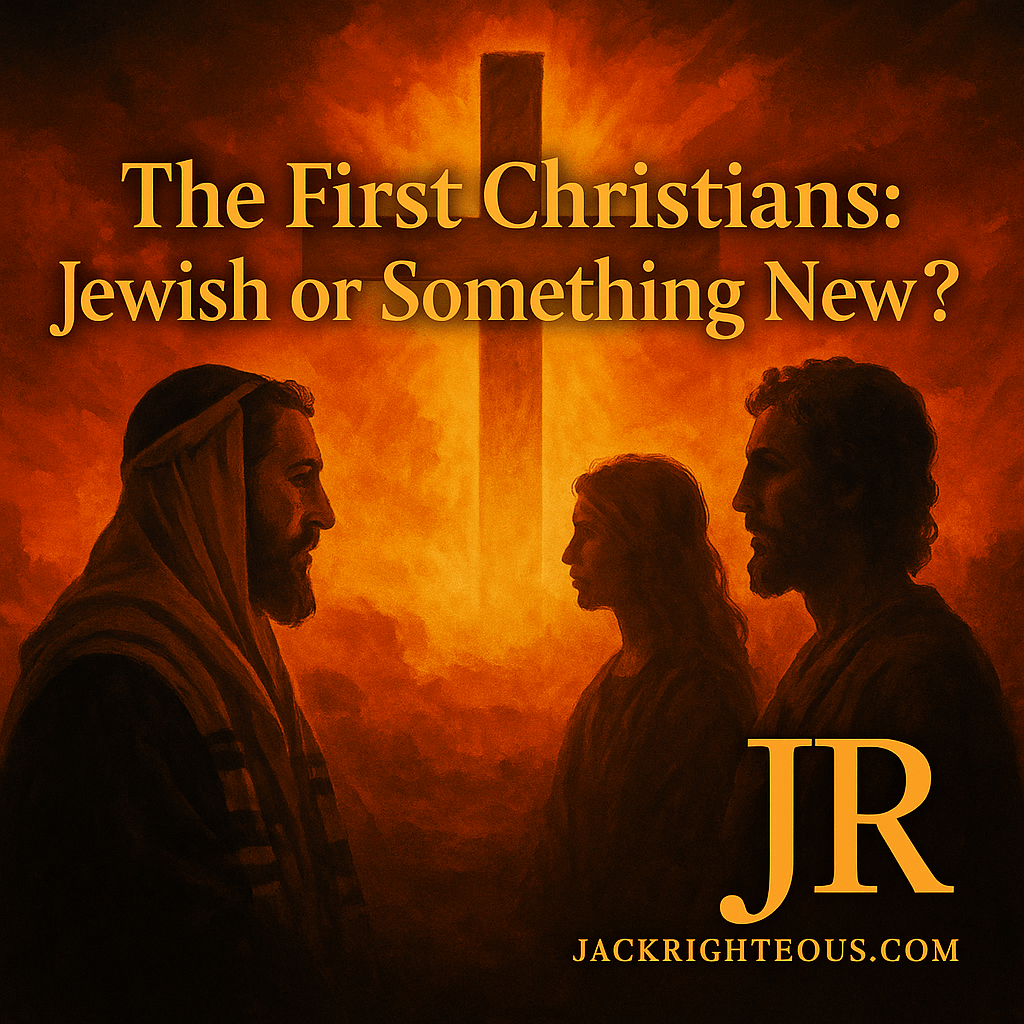
The First Christians Were Jewish: Jerusalem, Torah, Gentiles & the Gradual Split
Gary WhittakerJesus’ earliest followers were Jews participating in Jewish religious life. The idea that Jesus died and a fully separate religion called Christianity immediately appeared the next morning does not fit the earliest sources.
Jerusalem comes first
Acts portrays the first Jesus followers praying in Jerusalem, attending the Temple, reading Israel’s Scriptures and arguing from within Jewish categories about Messiah, resurrection and God’s kingdom. Peter, John and James are Jewish leaders of a Jewish Jesus movement.
Paul’s letters are earlier than Acts
Paul’s undisputed letters are the earliest surviving Christian writings. They show intense debate about whether Gentile followers of Jesus needed circumcision and full Torah identity. Paul strongly resists imposing circumcision on Gentiles while continuing to identify Israel, Abraham and the Jewish Scriptures as central to his theology.
Acts 15 and Gentile inclusion
Acts presents the Jerusalem Council deciding that Gentiles need not be circumcised. That does not mean Jewish believers were told to stop being Jewish. Acts 21 even portrays large numbers of Jewish believers as zealous for the law.
When did people start being called Christians?
Acts 11:26 says disciples were first called ‘Christians’ in Antioch. That label does not prove that everyone there understood Christianity as a fully separate religion in the later sense. Identities were still developing.
Nazarenes and Ebionites
Later Christian writers describe Jewish-Christian groups commonly called Nazarenes and Ebionites. Their exact origins, beliefs and relationship to the earliest Jerusalem community are difficult to reconstruct because much of our information comes from opponents writing later. They should not simply be projected backward as if Acts had already described later sects in full.
There was no single clean split
The destruction of Jerusalem and the Temple in 70 CE, the growth of Gentile-majority churches, disputes over Torah and Christology, and the Bar Kokhba revolt of 132–135 CE all contributed to widening separation. Different communities separated at different rates.
Claims that Jewish Christians universally refused the revolts and were consequently branded traitors by ‘both sides’ go beyond what can be established for every community. The history is more fragmented.
Nicaea did not create the split
The Council of Nicaea in 325 CE addressed the Arian controversy and the relationship of the Son to the Father. It did not create Christianity, make it Rome’s official religion, replace the Sabbath in one stroke or mark the first moment Christians became distinct from Jews. By 325, Jewish-Christian separation had already been developing for centuries.
What changed under Constantine?
Constantine’s reign transformed Christianity’s political position. Imperial support gave bishops new resources and influence, and fourth-century Christian rhetoric could become sharply anti-Jewish. Those developments matter, but they belong to a later stage of a much longer process.
The historical conclusion
The first Jesus movement was Jewish. Gentile inclusion changed its demographics and raised new covenant questions. The eventual formation of Christianity and rabbinic Judaism as increasingly distinct religious traditions was gradual, contested and regionally uneven.
Next question: How did early Christian doctrine develop?
The next step is to follow what happened as a Jewish Jesus movement expanded into Gentile-majority churches and began defining belief, authority and identity more explicitly.
Read: How Early Christian Doctrine Developed →
