
Family Bible Quiz: 10 Questions About Creation, Noah, Jesus and More
Share
Family Bible Quiz · Questions 61–70
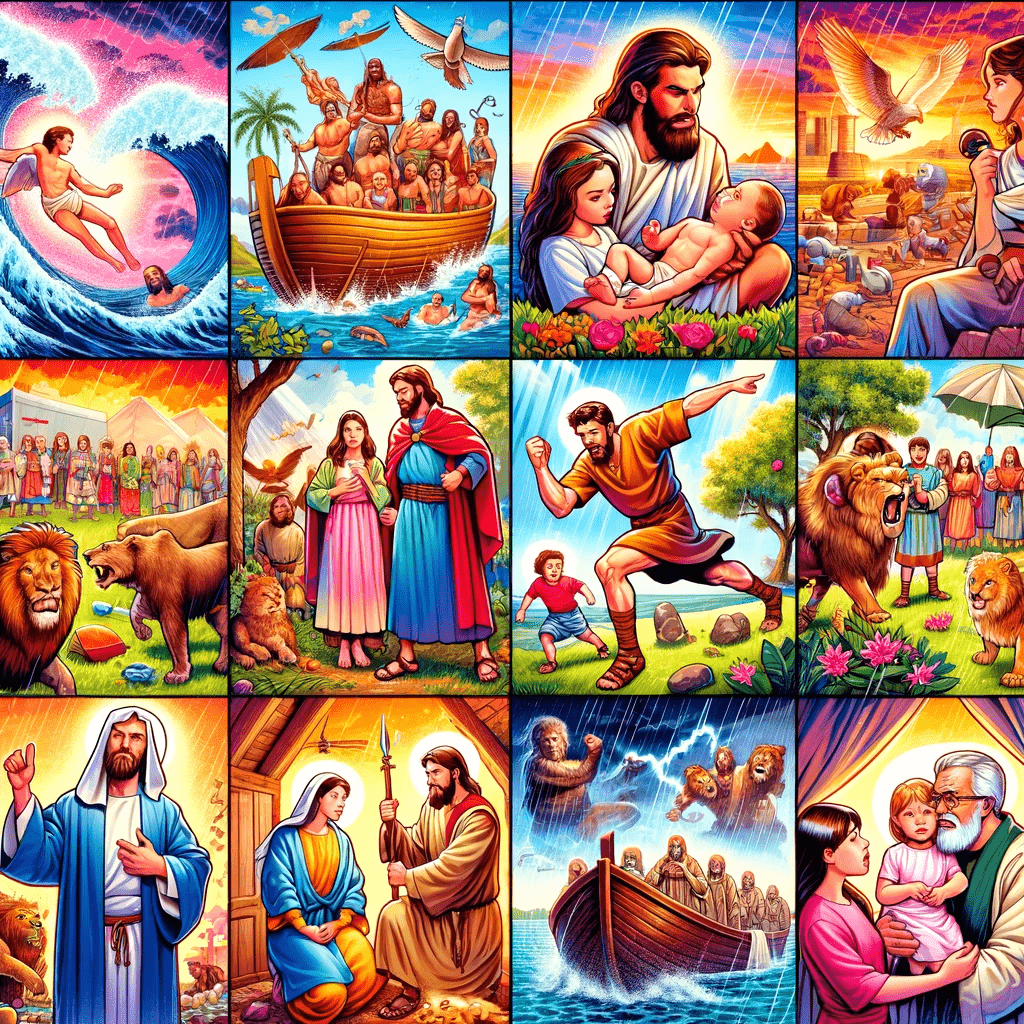
Creation, Noah, Jesus and More: 10 Bible Questions for Families
A good Bible quiz should do more than reward a quick answer. Use these ten questions to test what your family remembers, then read the surrounding passage and talk about what the story actually says.
This set moves from Genesis to Daniel and includes stories that are joyful, difficult and highly symbolic. Younger children may need extra explanation for Samson, Stephen and Daniel 7. The goal is not to make every passage simple. It is to help families ask better questions together.
Question 61
Humanity in God’s Image
Question: Who are named in Genesis as the first man and woman?
Answer: Adam and Eve.
Read: Genesis 1:26–27; 2:7, 18–25.
Context: Genesis 1 says humanity—male and female—is created in God’s image. Genesis 2 then tells the more focused garden account in which the man is formed from the ground and the woman is later made as his corresponding partner. Christians have drawn many theological conclusions from these chapters, but the text itself begins by grounding human dignity in God’s creative act.
Discuss: If every person bears God’s image, how should that affect the way we treat people who are different from us?
Question 62
Noah and the Ark
Question: Who built the ark in the Genesis flood account?
Answer: Noah.
Read: Genesis 6:13–22; 8:20–22; 9:8–17.
Context: The flood story includes judgment, preservation and, afterward, God’s covenant marked by the rainbow. Christian readers have sometimes seen the ark as a picture of salvation, but Genesis itself places special emphasis on God’s post-flood covenant with Noah, his descendants and every living creature.
Discuss: Why is it important to read beyond the ark itself and include the covenant in Genesis 9?
Question 63
Samson and the Lion
Question: Which judge killed a lion on the way to Timnah?
Answer: Samson.
Read: Judges 13:1–5; 14:5–9.
Context: Judges describes the Spirit of the Lord empowering Samson in the encounter with the lion. But Samson’s full story is not a simple superhero tale. He is a divinely called judge whose life also contains impulsiveness, violence, compromised judgment and tragic consequences. Strength and faithfulness are not the same thing.
Discuss: What is the difference between having an ability and using that ability wisely?
Question 64
David and Jonathan
Question: Which son of Saul formed a deep covenant bond with David?
Answer: Jonathan.
Read: 1 Samuel 18:1–4; 20:12–17, 41–42.
Context: David and Jonathan’s relationship is marked by affection, covenant loyalty and real political risk. Jonathan is Saul’s son and a potential heir, yet he repeatedly protects David when Saul seeks David’s life. Their story asks what loyalty looks like when family pressure, power and personal cost collide.
Discuss: When can being a loyal friend require courage rather than simply agreement?
Question 65
The Birth of Jesus
Question: In which Judean town does Luke say Jesus was born?
Answer: Bethlehem.
Read: Luke 2:1–7; Matthew 2:1–6; Micah 5:2.
Context: Luke places Jesus’ birth in Bethlehem during the journey connected with the census. Matthew explicitly connects Bethlehem with Micah 5:2 in presenting Jesus as the promised ruler. Christians therefore read the Bethlehem tradition messianically, while still benefiting from reading Micah in its own prophetic context rather than treating it as an isolated prediction line.
Discuss: Why is it useful to read both the New Testament citation and the Old Testament passage it comes from?
Question 66
Mary, Martha and Listening to Jesus
Question: Which two sisters appear in Luke 10 when Jesus is welcomed into a home?
Answer: Martha and Mary.
Read: Luke 10:38–42.
Context: Martha serves while Mary sits at Jesus’ feet and listens. The passage is sometimes reduced to “active people versus contemplative people,” but Jesus does not condemn service itself. His correction addresses Martha’s distraction and anxiety while affirming Mary’s choice to receive his teaching.
Discuss: How can a good responsibility become distracting when worry begins to control it?
Question 67
The Transfiguration
Question: Which three disciples went with Jesus up the mountain when his appearance was transformed?
Answer: Peter, James and John.
Read: Matthew 17:1–8; Mark 9:2–8; Luke 9:28–36.
Context: The Gospels say the event happened on a high mountain but do not name the mountain. Moses and Elijah appear, a cloud overshadows them, and the heavenly voice directs the disciples to listen to Jesus. The scene reveals Jesus’ glory and connects his mission with Israel’s Scriptures.
Discuss: What details in the passage tell the disciples that this is about more than a spectacular visual experience?
Question 68
Thomas and the Resurrection
Question: Which disciple said he wanted evidence before believing the others’ report that Jesus had risen?
Answer: Thomas.
Read: John 11:16; 14:5; 20:24–29.
Context: Thomas is often remembered only as “Doubting Thomas,” but John portrays him more fully. Earlier he is willing to go with Jesus toward danger, and he asks direct questions when he does not understand. After encountering the risen Jesus, Thomas gives one of John’s strongest confessions: “My Lord and my God.”
Discuss: What is the difference between honest questioning and refusing to consider an answer?
Question 69
Stephen
Question: Which early Christian witness was killed by stoning in Acts 7?
Answer: Stephen.
Read: Acts 6:8–15; 7:54–60; 8:1.
Context: Stephen’s death is traditionally described as the first Christian martyrdom recorded in Acts. The scene is not presented as violence Christians should seek. It shows the seriousness of the conflict surrounding the early Jesus movement, Stephen’s witness under pressure, and the presence of Saul—later Paul—among those approving his death.
Discuss: How can Christians value courage without romanticizing suffering or violence?
Question 70
Daniel’s Vision of Four Beasts
Question: Which prophet sees four beasts rise from the sea in a night vision?
Answer: Daniel.
Read: Daniel 7:1–18, especially verses 17–18.
Context: Daniel is told that the four beasts represent four kings or kingdoms. The chapter belongs to apocalyptic literature, using symbolic imagery to speak about violent earthly powers, God’s judgment and the coming rule associated with “one like a son of man.” Christians disagree about how particular kingdoms and later events should be mapped onto the vision. The passage itself gives families a firm starting point: human empires are temporary, while God’s sovereignty is not.
Discuss: Before trying to identify every symbol with a modern headline, what does Daniel 7 itself say about power, judgment and God’s kingdom?
What These Ten Questions Teach Beyond Trivia
Questions 61–70 cover very different kinds of biblical writing: creation narrative, flood narrative, Judges, historical narrative, Gospel, Acts and apocalyptic vision. Reading all of them in exactly the same way can flatten the Bible.
A useful family habit is to ask three questions after every quiz answer: What does the passage actually say? What kind of biblical writing am I reading? What question does the surrounding context raise that the short answer cannot settle?
That habit turns Bible trivia into Bible study.
Continue the study
Create What You Love | Love What You Create.
