
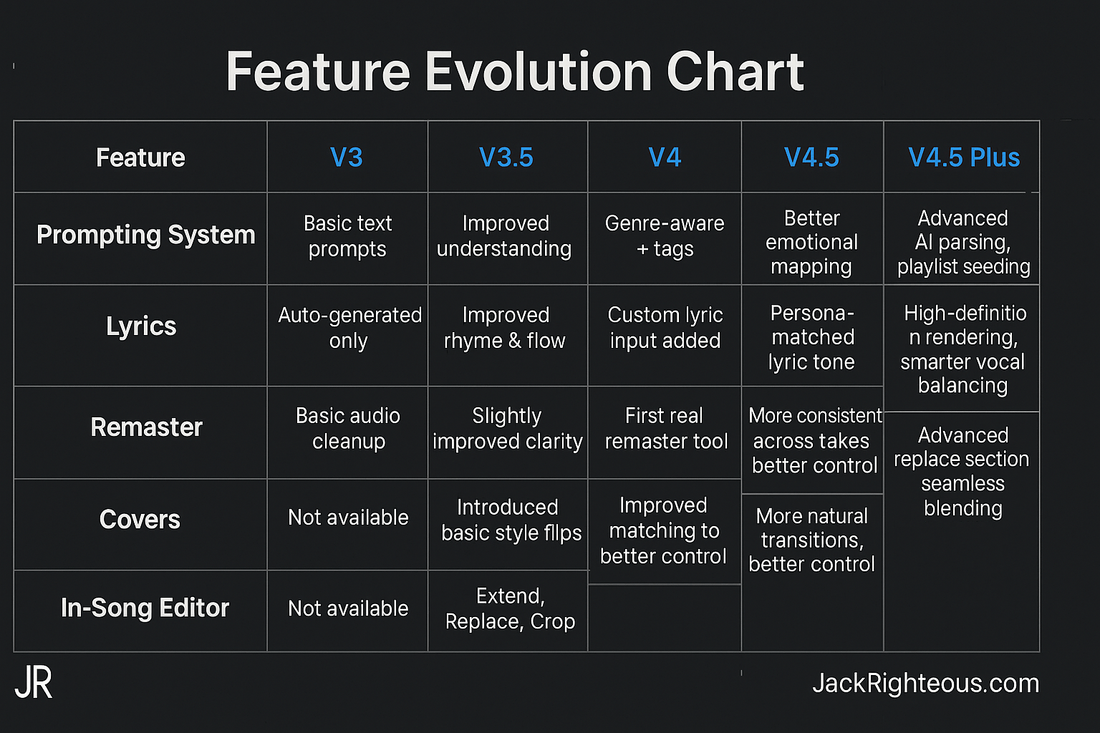
Evolution of Suno AI: From V3 to V6 — What Changed and What Still Matters
Gary WhittakerUpdated September 13, 2026
Suno did not just get better. The job of the creator changed.
When this guide was first published, the story ended around V4.5 Plus. Since then, Suno has moved through V5, V5.5 and into the V6 model family. The biggest change is not one feature. It is the shift from asking for a song to directing, editing and refining a production.
The short version
V3 made full-song AI creation feel practical. V4 improved fidelity and consistency. V4.5 pushed prompt detail, genre blending and longer-form creative direction. V5 and V5.5 moved the platform further toward controlled production workflows. V6, released September 9, 2026, makes editing and producer-style intention much more central.
That means older Suno lessons are not automatically useless. The durable skills — describing sound clearly, choosing arrangement intentionally, evaluating generations and revising toward a target — matter more now, not less.
V3: the full-song breakthrough
V3 was the point where many creators stopped treating AI music like a novelty and started treating it like a usable creative tool. You could describe a song, add lyrics, choose a musical direction and get a surprisingly complete result.
What creators learned: broad genre labels were not enough. Better results came from describing mood, instrumentation, vocal character, tempo feel, song structure and emotional purpose.
V4: quality became easier to hear
V4 raised expectations around clarity, coherence and polish. The difference was not simply “better audio.” Creators could hear more clearly when an idea was under-directed. Weak prompting became easier to spot because the model was capable of producing more convincing results when the direction was strong.
What still matters: your first generation is not your finished song. Compare versions, identify what changed, keep the parts that serve the song and refine the parts that do not.
V4.5 and V4.5 Plus: prompting became production language
This was the period covered by the original version of this article. More creators began using longer, more descriptive prompts, blending genres intentionally and thinking in sections rather than relying on one short style label.
The important lesson was not that there was a secret syntax. It was that specific creative direction produced better creative decisions. That lesson survives V6.
A note on old prompt tags
Older community workflows often used bracketed tags or custom meta-style labels as shorthand. Some can still be useful as creator notation, but unless Suno documents a tag as an official command, do not treat it like guaranteed platform syntax. Under V6, plain-language intention and clear producer direction deserve more weight.
V5 and V5.5: from generation toward control
By the V5/V5.5 period, the broader Suno workflow was becoming less about repeatedly rolling generations and more about making decisions around versions, sections, edits, arrangement and reusable creative identity.
This matters because it changed the creator mindset. Instead of asking, “Did Suno make a good song?” the stronger question became, “What part of this production is working, and what do I want changed?”
Important distinction: Suno's current New Voices documentation still tells creators to use v5.5 for the New Voices feature and says other models do not support it. V6 exists, but that does not make every feature a V6 feature. Keep those workflows separate unless Suno updates its documentation.
V6: the creator becomes more like a producer
Suno launched the V6 model family on September 9, 2026. The current family includes v6 as the flagship model, v6-wild as the more experimental option and v6-mini as the lighter, faster model. v6 and v6-wild are paid-plan models, while v6-mini is available across plans.
V6 supports songs up to eight minutes and brings the model into Suno's Remix & Edit workflows. Suno also emphasizes plain-language targeted editing: instead of thinking only in terms of regeneration, you can increasingly describe what should change and work on specific parts of a song.
What V6 changes in practice
- Longer canvas: up to 8-minute generations.
- More targeted revision: V6 works across Remix & Edit tools including workflows such as Extend, Cover and Replace Section.
- Stronger plain-language direction: explain the musical problem you want solved instead of relying on supposed magic commands.
- More production thinking: arrangement, section choice, pacing, contrast and editing matter alongside the initial prompt.
- Model choice matters: flagship, experimental and lighter/faster options are now separate creative decisions.
What never stopped mattering
The model changed. These creator skills did not:
- Know what the song is trying to do. Mood without purpose produces attractive randomness.
- Describe sound in layers. Genre, rhythm, instrumentation, vocal character, energy, structure and emotional arc work together.
- Compare before you commit. One generation is evidence, not a verdict.
- Edit with intention. Identify the exact section or decision that needs work.
- Keep a human creative record. Your lyrics, prompts, edits, arrangement decisions, stems, DAW work and documentation can matter when you move from creation toward rights and release.
A simple V6-era workflow
Write the song's purpose, sound and emotional destination.
Create enough versions to understand the direction, not endless versions without a decision.
Name what is working and what specifically needs to change.
Use section-level and plain-language tools where they fit instead of restarting everything.
Decide whether Suno is the endpoint or whether stems, BandLab/DAW work, external vocals or other tools belong in the final production.
Where the original V4.5 Plus series still fits
The older walkthroughs linked from this article remain useful as a record of how Suno's interface and creator workflow evolved. They should be read as historical training unless a page has been specifically refreshed for V6. The principles worth carrying forward are navigation confidence, prompt clarity, iteration discipline and learning how each control affects your creative decision-making.
For the current V6 era, start with the refreshed lessons on structure and meta-style prompting, editing and chord-change reality, and the broader Jack Righteous creator system.
The bigger lesson
The advantage is no longer knowing one clever Suno prompt. The advantage is knowing what you want, recognizing what the model gave you, and making the next creative decision on purpose.
Next best steps
How to Use Jack Righteous Creator Training — understand how the free training, paths and deeper resources fit together.
Mastering Suno AI: Create & Refine Music Tracks — move from isolated prompting into a repeatable creation and refinement system.
Source note: Current V6 details were checked against Suno's official V6 release notes and current Suno Help Center documentation on September 13, 2026. Product behavior can change; when Suno updates a feature, the official documentation should take priority over older community shorthand.
Original publication preserved as an evolution guide; substantially refreshed for the V6 era rather than replaced with a new duplicate article.
