
Suno AI Music Articles & Updates
Suno Uploaded Audio Matches Existing Work: What to Do
Suno says your uploaded audio matches existing work? Learn what the warning does and does not prove, how to troubleshoot it without trying to evade detection, what evidence to keep, and when to contact Suno Support.
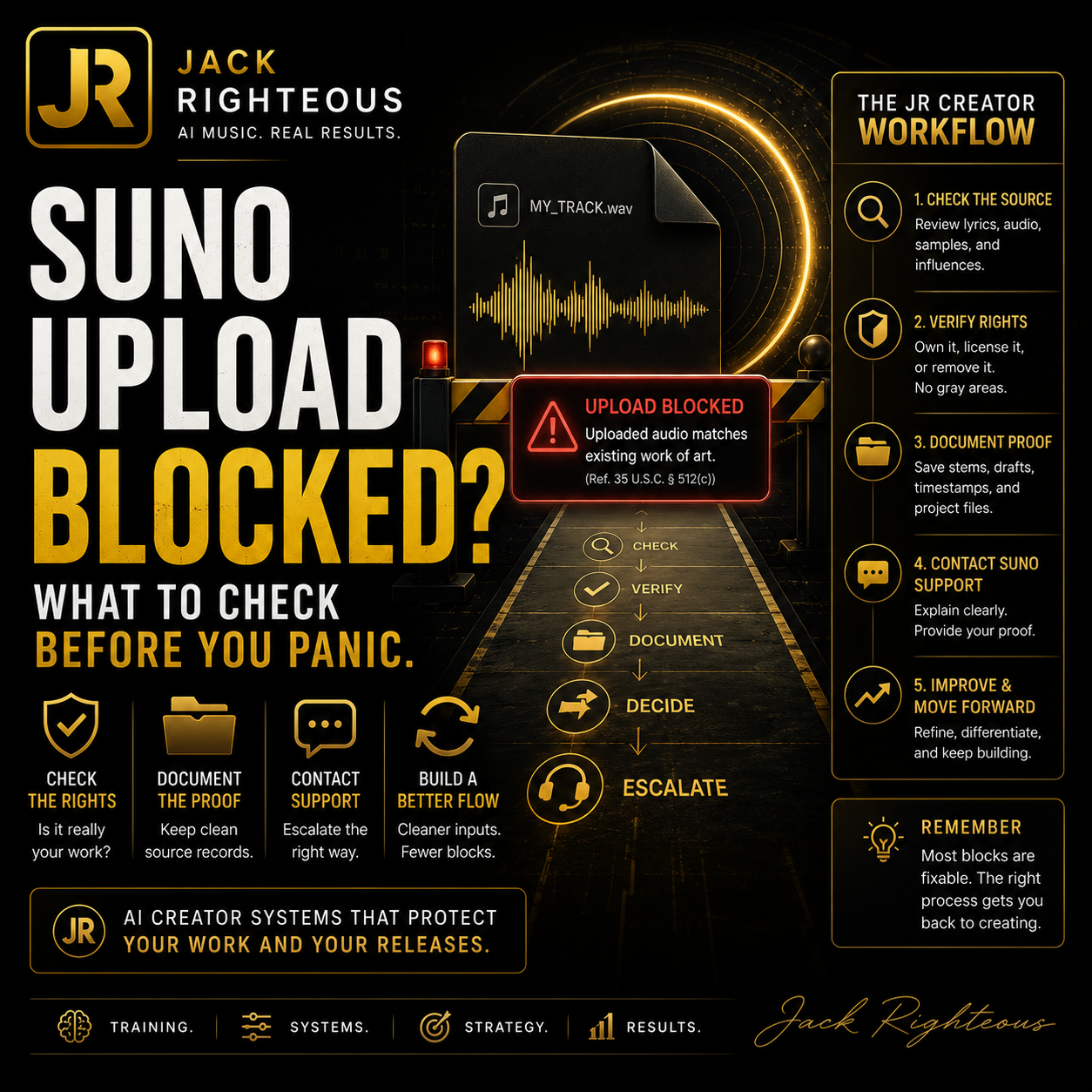
AI Audio Uploads · Suno Troubleshooting
If Suno says your uploaded audio “matches existing work,” stop before regenerating, changing pitch, or repeatedly retrying. The useful next move is to separate three questions: what did the platform block, what rights do you actually have, and what evidence can you keep or provide?
Reviewed and source-checked: August 14, 2026.
Start with the distinction
One warning. Three different questions.
Suno requires users to have the rights, licenses, consents and permissions needed for material they submit. But Suno does not publicly document every detector, reference source or threshold behind this particular upload warning. So the warning should be treated as a platform-level result, not a published legal ruling on your ownership.
1 · Platform
Did Suno accept the upload?
This is the immediate technical/moderation result. A block means the platform did not permit that upload through the feature you were using.
2 · Rights
Do you have permission?
Separately ask whether you created or properly licensed every relevant recording, composition, loop, beat, sample, voice and collaborator contribution.
3 · Evidence
Can you explain the source?
Keep project files, licenses, release records and source history so you can understand the problem and respond clearly if support asks for details.
Diagnostic hypotheses
If you own the song, what should you inspect?
The items below are sensible places to investigate, not confirmed explanations of Suno’s internal matching system. Suno has not publicly disclosed the exact mechanism for this warning.
| Possible factor to inspect | What to check | Controlled diagnostic |
|---|---|---|
| Previously released recording | Whether the exact master or a closely related version has already been distributed, posted or entered into another rights-management system. | Test an unreleased original stem or newly recorded excerpt you control. |
| Non-exclusive loop, beat or sample | License terms and whether the same audio can legally appear in many other creators’ tracks. | Remove that element and retest the same section. |
| Collaborator or backing material | Who supplied the performance, beat, stem, reference or accompaniment and what permission you have. | Export a version containing only your own controlled material. |
| Background or captured media | TV, radio, livestream, reference playback, venue audio or another recording accidentally captured. | Record the passage cleanly in isolation. |
| Preset/demo accompaniment | Keyboard styles, app loops, demo grooves, stock phrases or other reused audio inside the project. | Replace the suspect accompaniment with an original part. |
| Possible false positive or unknown cause | Your project history, source dates, stems and licenses. | Use a short clean excerpt, document the result, then escalate to Support if it remains blocked. |
Controlled troubleshooting
Use this seven-step workflow before you spend more credits
The goal is to learn what changes the result—not to make the file harder for a detector to recognize.
Save a screenshot or exact wording, the date, the Suno feature you were using and which file was uploaded.
Do not troubleshoot from memory. Note the filename, version, export date and project it came from.
Mark each important element as original, exclusively licensed, non-exclusively licensed, third-party with permission, or unknown.
Use a short excerpt containing only material you created and control. Keep the musical idea recognizable enough that the test is useful.
Remove or replace one suspected ingredient at a time. If you change five things, you will not know what mattered.
Save blocked and successful exports with notes. That gives you a repeatable creator record rather than a pile of guesses.
If a clean, controlled file you believe you have the required rights to use is still blocked, contact official Suno Support. Suno currently lists support@suno.com as its official support email.
Rights ≠ platform result
Is the warning a copyright decision?
No—not by itself. Suno’s Terms require you to have the necessary rights and permissions for submissions, but the platform warning itself is not presented by Suno as a court or copyright-office determination. Copyright protection and ownership can also vary by jurisdiction and by the human contribution involved.
“I paid for the tool, so I own everything.”
That is too broad. Suno’s paid-tier commercial-use terms and any rights Suno assigns in generated output do not create rights in third-party material you uploaded, sampled or incorporated.
“The platform blocked it, so I must not own it.”
Also too broad. Platform acceptance and legal ownership are separate questions. Your job is to inspect the source, permissions and evidence rather than infer a legal conclusion from one automated result.
JR best practice
Keep a mini proof record before uploading reference audio
This is a Jack Righteous creator practice—not a claim that Suno requires you to submit all of these items with every upload.
- Source file: filename, version and where it came from.
- Creation record: project file, stems, recording date or generation history.
- Contributors: who performed, wrote, produced or supplied material.
- Licenses: loops, beats, samples, stock assets and whether permissions are exclusive or non-exclusive.
- Prior releases: distributor, release date and identifiers such as ISRC/UPC when relevant.
- AI-tool record: platform/model used and the date you checked the applicable terms.
- Test history: what file was blocked, what one variable you changed and what happened next.
Choose by the actual problem
Your next step may be free—or it may simply be Suno Support
Do not buy a larger training package just to solve one upload warning.
Rights unclear · Free
Unsure what you actually have permission to use?
Start with the free AI Music Monetization & Rights Clarity 101 guide.
Check your rights basicsRelease record · C$5
The track is yours, but your documentation is scattered?
The AI Music Ownership & Release Readiness Tracker organizes contributors, AI tools, uploads, permissions, identifiers and unresolved release questions.
Review the release trackerTrack quality · Free
The upload issue is solved, but the song still needs review?
Use the free AI Track Validation Checklist to evaluate the track separately from platform policy.
Validate the trackQuick answers
Uploaded-audio warning FAQ
Does “matches existing work” prove I infringed copyright?
No. It tells you Suno blocked the upload through its platform process. Rights and copyright questions still need to be evaluated separately.
Can my own previously released song be worth checking?
Yes—as a diagnostic possibility. If the exact recording has already been released or used elsewhere, document that history and keep distributor/project records. Suno does not publicly state that prior release is the confirmed cause of this exact warning.
Does a loop or beat license guarantee the upload will pass?
No. A license can give you permission while the same non-exclusive audio remains available to other creators. Legal permission and automated platform acceptance are separate questions.
Should I change pitch or speed to get around the warning?
No. This guide recommends controlled troubleshooting, not evasion. Altering audio to defeat a checker can hide the real source problem and leave the rights question unresolved.
Should I keep regenerating the song?
Not until you understand whether the source upload is the problem. Repeated generation can spend credits without teaching you anything about the blocked file.
Does paying for Suno guarantee copyright protection?
No. Suno distinguishes commercial-use rights from copyright protection, which can depend on jurisdiction and the facts of the work.
Who is official Suno Support?
Suno’s help center currently identifies support@suno.com as its official support email and says Discord is peer-to-peer rather than official support.
Can Jack Righteous remove the warning from my Suno account?
No. Jack Righteous is independent creator education and support, not Suno Support. JR can help you organize the problem and next questions, but only Suno can address an account-specific platform decision.
Primary sources
Official Suno references checked for this update
Educational information only. This article does not determine copyright ownership, provide legal clearance or guarantee Suno acceptance. Create What You Love | Love What You Create.
Continue the Suno workflow
Do not stop at one Suno feature or prompt.
Connect setup, song development, editing, rights and release through the complete Suno guide and workflow hub.

Discussion