Mont-Real Geschichten: Glaube, Kultur & Schöpferleben

Family Bible Quiz: 10 Questions About Moses, Jesus, Elijah and More

Published December 19, 2023Last updated August 20, 2026By Gary Whittaker
What this guide will help you do

A family-friendly Bible quiz with 10 questions about Moses, the lost sheep, Solomon’s Temple, Lydia, Elijah, Jesus feeding the 5,000, Naaman, Gideon, Paul in Athens and the New Jerusalem—plus Scripture references, careful context and discussion prompts.

Bible Wonders Explored: Family Quiz on Moses, Jesus, Elijah & More - Jack Righteous
Christian Family · Bible Quiz · Questions 51–60

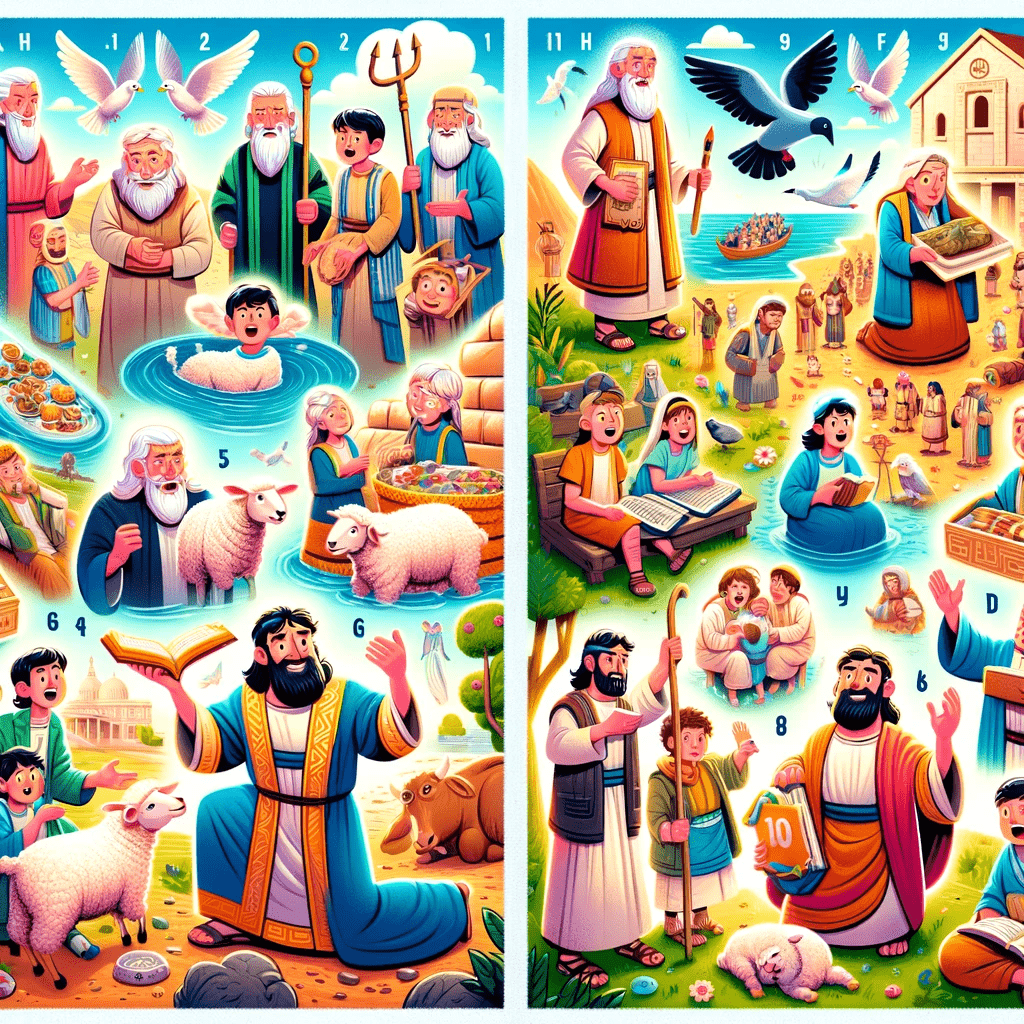
Family Bible Quiz: Moses, Jesus, Elijah and More

This set moves from Sinai and the lost sheep to Elijah, Naaman, Paul in Athens and Revelation’s New Jerusalem. Answer the question first, then read the passage around it. The goal is not to turn Scripture into trivia—it is to use the question as a doorway into better Bible reading.

Each answer below includes a Scripture reference, a context note and one family discussion prompt. Some stories involve illness, warfare, idolatry and end-times imagery, so parents and caregivers should adapt the level of detail to the age and maturity of the children with them.

A useful family rule: do not turn a descriptive Bible story into a promise that God must repeat the same outcome for us. Ask what the text actually says, what it reveals in context, and what faithful response is reasonable.

How to Use This Quiz

Answer from memory.

Let everyone respond before opening the Bible.

Read the surrounding passage.

The verse containing the answer is rarely the whole story.

Separate description from promise.

A miracle or provision in one biblical account is not automatically a guarantee of the same result for every believer.

End with one good question.

Discussion builds understanding better than simply counting correct answers.

The 10 Questions

Question 51 · Moses and Sinai

Who received the covenant tablets from God on Mount Sinai?

Answer: Moses.

Read
Exodus 19–20; 31:18; 32–34
Context
The Ten Commandments belong to the larger Sinai covenant story. The tablets are important, but so are Israel’s preparation, the golden calf crisis, Moses’ intercession and the covenant’s renewal. Reading only a list of commands misses the narrative around them.
Talk about it
Why might it matter that the commandments are given inside a covenant relationship rather than appearing as an isolated rulebook?
Question 52 · The Lost Sheep

Which parable pictures a shepherd going after one sheep that has gone missing?

Answer: The Parable of the Lost Sheep.

Read
Luke 15:1–7; compare Matthew 18:10–14
Context
Luke places the parable in response to criticism that Jesus welcomes sinners. Matthew uses a related version in a teaching about care within the community. Comparing the settings shows why context matters even when the central image is familiar.
Talk about it
What does the shepherd’s search communicate about the value of someone who has become lost or excluded?
Question 53 · Solomon’s Temple

Which king oversaw the building of the first temple in Jerusalem described in 1 Kings?

Answer: Solomon.

Read
1 Kings 5–8; 1 Chronicles 22
Context
Solomon builds the temple, while Chronicles also emphasizes David’s preparation for it. At the dedication, Solomon himself acknowledges that no building can contain God. The temple is central to Israel’s worship story without making God reducible to a structure.
Talk about it
What is the difference between treating a place as sacred and believing God can be contained by that place?
Question 54 · Lydia

Which merchant from Thyatira responded to Paul’s message in Philippi and welcomed his group into her home?

Answer: Lydia.

Read
Acts 16:11–15, 40
Context
Lydia is from Thyatira in Asia Minor but is encountered in Philippi in Macedonia. She is the first named person in Acts to respond after Paul’s Macedonian vision, but calling her simply “the first European convert” is more certain than the text itself requires.
Talk about it
What do Lydia’s work, hospitality and household role add to the picture of the early Christian movement?
Question 55 · Elijah and the Ravens

Which prophet receives food brought by ravens while staying near the Kerith ravine during a drought?

Answer: Elijah.

Read
1 Kings 17:1–16
Context
The ravens are one episode in a larger drought narrative that soon moves to a widow facing severe scarcity. The story depicts extraordinary provision for Elijah, but it should not be turned into a promise that faithful people will always receive material needs in miraculous ways.
Talk about it
How does the widow’s scarcity complicate an overly simple lesson such as “God will always provide exactly what we need in the way we expect”?
Question 56 · Feeding the 5,000

Who feeds a crowd of about 5,000 men, besides women and children in Matthew’s telling, using five loaves and two fish?

Answer: Jesus.

Read
Matthew 14:13–21; Mark 6:30–44; Luke 9:10–17; John 6:1–15
Context
This feeding is narrated in all four canonical Gospels. The accounts emphasize compassion, abundance and Jesus’ identity, while John develops the event further through the Bread of Life discourse. It is more than a lesson about stretching limited resources.
Talk about it
What changes when you compare how two different Gospels tell the same feeding story?
Question 57 · Naaman

Which Aramean commander is cleansed of his skin disease after following Elisha’s instruction to wash in the Jordan seven times?

Answer: Naaman.

Read
2 Kings 5
Context
The story includes an unnamed Israelite girl, political tension, Naaman’s anger, servants who challenge him, cleansing, confession and Gehazi’s later greed. Naaman’s outcome should not become a formula that physical healing is guaranteed when someone is humble or obedient enough.
Talk about it
Which people with little social power help move Naaman toward the turning point in the story?
Question 58 · Gideon

Which judge is called while Israel is oppressed by Midian and initially questions how God can be with his people?

Answer: Gideon.

Read
Judges 6–8
Context
Gideon’s story begins with fear, questions and a call to resist Midian, but it does not end as a simple inspirational tale. Later chapters include vengeance, violence, an ephod that becomes a snare and a complicated legacy. Biblical heroes should be read as full characters, not flattened into motivational slogans.
Talk about it
Why is it useful to read the end of Gideon’s story before deciding what lesson his beginning teaches?
Question 59 · Paul in Athens

Who speaks at the Areopagus in Athens after seeing the city’s many objects of worship?

Answer: Paul.

Read
Acts 17:16–34
Context
Paul begins from things his audience recognizes, including an altar and lines familiar from Greek poets, but he does not merely reshape his message to fit the culture. He uses those points of contact to challenge idolatry and proclaim God, repentance and resurrection.
Talk about it
How can someone understand another culture well enough to communicate clearly without simply agreeing with everything in it?
Question 60 · New Jerusalem

Who reports the vision of the holy city, New Jerusalem, coming down from God in Revelation 21?

Answer: John, the visionary narrator of Revelation.

Read
Revelation 21–22
Context
Revelation ends not simply with people escaping earth for heaven, but with new creation imagery and the holy city coming down from God. Christian traditions differ on how literally particular symbols should be read, so the passage deserves attention to its imagery, Old Testament echoes and larger hope rather than turning every detail into a timetable.
Talk about it
What images in Revelation 21–22 communicate restoration, justice, presence and hope?

What This Set Teaches Beyond Trivia

  • Context prevents slogans. Gideon, Naaman and Elijah all become more complicated when the entire narrative is read.
  • Miracle stories are not automatic guarantees. Description and promise are not the same thing.
  • People on the margins matter to the biblical story. Lydia, Naaman’s servants and the unnamed Israelite girl are not disposable side characters.
  • Good communication begins with understanding. Paul knows his Athenian audience, but understanding does not mean surrendering conviction.
  • Christian hope is larger than escape. Revelation’s ending points toward God’s presence, renewal and the defeat of death.

A Four-Step Family Study Method

  1. Observe: What does the passage actually say?
  2. Compare: Is there another biblical account or nearby passage that adds context?
  3. Guard against formulas: Am I turning one person’s outcome into a universal promise?
  4. Respond: What faithful truth, warning, question or practice can we reasonably carry forward?

Continue the Family Bible Quiz

Review Questions 41–50 about Deborah, Jesus, Jacob and more, or return to the Ruth, Moses and Jesus quiz.

Go Deeper Than the Quiz

Want biblical context, study paths and related Christian articles?

Use Righteous Kingdom as the main Bible study hub.

This family quiz is an educational Bible-study activity. Scripture references are supplied so families can read the passages in the translation they normally use and discuss age-appropriate context together.

Create What You Love | Love What You Create.

Continue the wider investigation

Technology is also about control, resources and human consequences.

Continue through Tech Culture & Power for connected reporting on infrastructure, ownership and public impact.

Discussion

Leave a comment

articleall levels
On this page

    Your next move

    Turn the reading into useful work.

    Apply this now

    Complete one action before opening another guide.

    Write down the most important decision this article changes, then apply it to the project while the reasoning is still fresh.

    Continue learning

    Keep the subject connected.

    Use the public library to compare related guidance before changing the project.

    Continue with public guidance →
    Go deeper

    Use structured training for ordered work.

    Move into the member system when the project needs a sequence, templates and application—not another isolated tip.

    Explore structured training →
    Use a resource

    Support the next action.

    Use a workbook, checklist or ASK JACK route only when it reduces friction in the work.

    Open the supporting route →

    The Righteous Beat

    Get the week’s most useful creator guidance, platform changes and free resources.

    Join the free newsletter →