
Creator Commerce: Erstellen, Verkaufen & Skalieren Sie Ihre Angebote
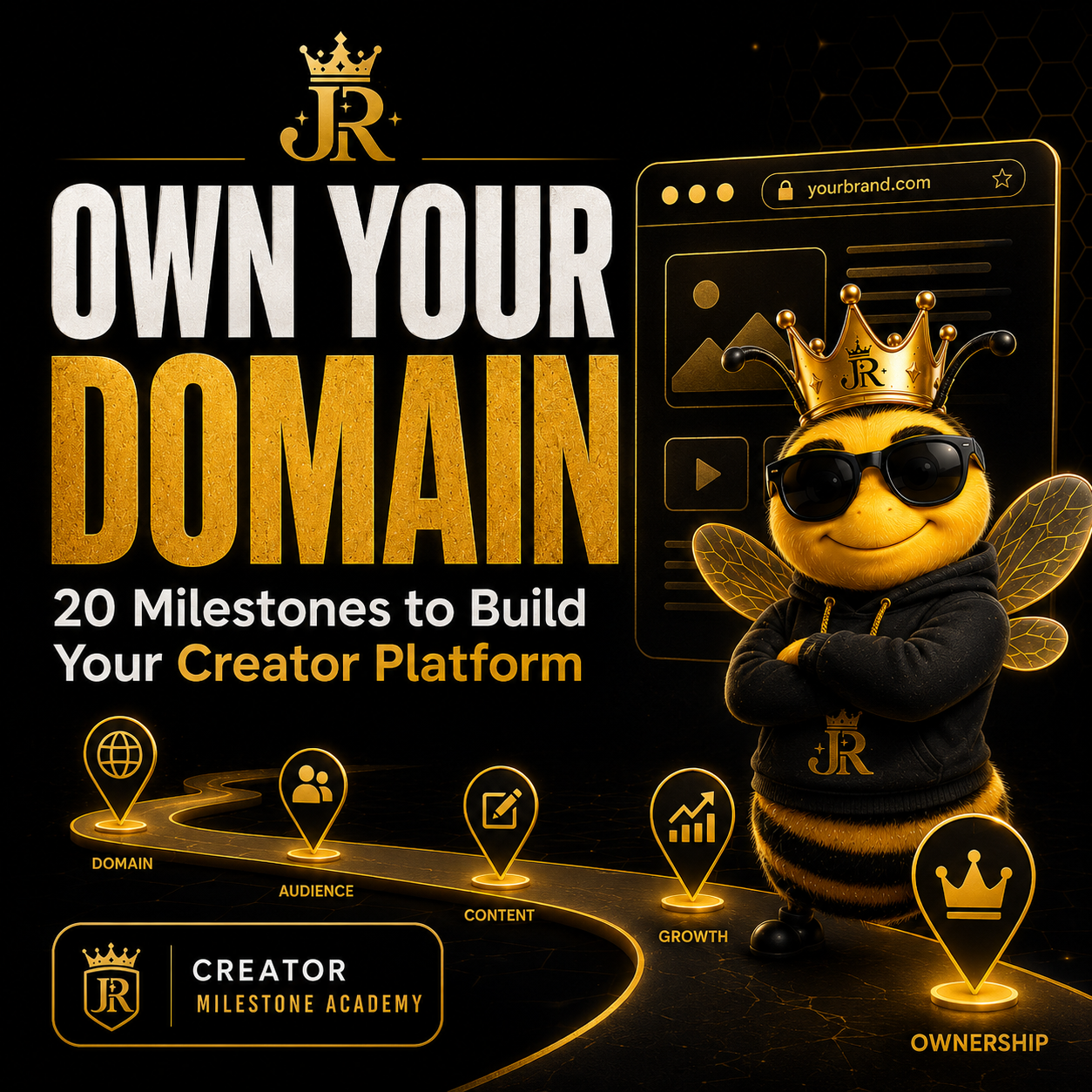
Own Your Domain: The 20-Milestone Roadmap to Build Your Creator Platform
Own your domain and build a creator website that actually works. Use this practical 20-milestone roadmap to connect your brand, audience, content and offers without getting lost in technology.
The Creator Milestone Academy
Your social profiles can introduce you. Your domain should explain you, connect your work and give people a clear reason to stay.
A domain is not just a web address. It is the front door to the creator platform you control: your projects, content, email list, offers, proof and next steps—all connected in one place.
This free 20-milestone roadmap helps creators, authors, artists, educators, consultants and podcasters identify what their website needs next without turning the process into a technical endurance test.
First, the good news: you do not need to build an internet empire this weekend
You need one useful home that works.
That means a visitor can arrive, understand what you create, see why it matters and choose a clear next step. The first version does not need every feature, every product or every idea you may create later.
It needs to be clear, credible and connected.
What does “own your domain” actually mean?
Owning your domain means controlling the web address that acts as the primary home for your creator identity, content, audience pathways and offers.
It does not mean quitting YouTube, Facebook, Instagram, TikTok, Amazon, Patreon, Skool or any other platform that helps people find you. Those platforms can remain valuable discovery and community channels.
The difference is that your domain gives all that activity a centre of gravity.
Why creators still need a website
Social platforms are built around feeds, formats and rules chosen by someone else. That can be excellent for reach, but it is rarely the best way to explain a growing creator business.
- One credible home: a stable address for your biography, projects, products, services and contact routes.
- A clearer visitor journey: people can move from curiosity to the page, resource or offer that fits them.
- A direct audience path: your email signup and customer relationships are not trapped inside a social feed.
- Searchable long-form content: guides, articles and project pages can keep working after a post disappears.
- Connected creator assets: your music, books, podcasts, training, campaigns and services can support one another.
- Better evidence: you can see which pages, messages and calls to action are actually helping.
Find your starting point in under two minutes
Choose the statement that sounds most like your current situation.
I only have social profiles
Start with purpose, audience, message, domain direction and the smallest useful version of your website.
I own a domain, but the site feels empty
Focus on page structure, navigation, core content and one complete visitor journey.
I have a website, but it is not doing much
Focus on audience capture, content, offers, measurement and controlled improvement.
The rule that keeps this path useful
Start with the first milestone whose result you cannot prove.
Do not jump to the milestone that sounds exciting. A polished homepage cannot repair an unclear purpose. More traffic cannot repair a broken visitor route. More content cannot repair an offer nobody understands.
The 20-milestone Own Your Domain journey
This is not a random website checklist. Each phase produces something the next phase needs, so strategy stays ahead of design and the website stays ahead of promotion.
Phase 1: Define the foundation
Clarify what you are building, who it serves, what the website must help them do and which creator assets belong in the first version.
Phase 2: Shape the message and structure
Turn the idea into a clear promise, visitor journey, page architecture, navigation plan and practical production sequence.
Phase 3: Build and validate the website
Complete one strong core page first. Use what you learn to produce the remaining pages, connect the site and quality-check the complete experience.
Phase 4: Prepare, launch and verify
Confirm domain control, forms, links, search foundations, redirects, measurement, backups and the real visitor experience on desktop and mobile.
Phase 5: Build audience, content and conversion paths
Create a permission-based audience route, a sustainable content system and clear pathways into useful resources, products or services.
Phase 6: Grow, measure and improve
Activate direct-to-fan growth, review meaningful evidence and complete your first 90-day owned-domain improvement cycle.
What should a creator website actually include?
A useful creator website is not measured by how many pages it has. It is measured by whether the right visitor can understand the work and take the right next step.
- A clear front door: who you help, what you create and where a new visitor should begin.
- An about or credibility page: enough context to understand who is behind the work and why it deserves attention.
- Strong project or offer pages: clear value, context, proof, access and next action.
- An owned connection route: email signup, contact, purchase, booking, download or another route you can maintain responsibly.
- Useful internal links: related content and offers should help one another instead of sitting alone.
Your website may also need a music hub, author page, podcast archive, store, service page, resource library, training area, community route or press page. The roadmap helps you decide what belongs now and what should wait.
Your domain-readiness check
Answer each question with yes, partly or not yet. Your first “not yet” is a strong candidate for your current milestone.
- Can I explain what this website is for in one clear sentence?
- Do I know the primary visitor and what brings them here?
- Does my domain support the identity I intend to build?
- Can a new visitor tell what I create within a few seconds?
- Is there one obvious starting point instead of ten competing choices?
- Do my core pages have clear jobs and calls to action?
- Can visitors move between related content, projects and offers?
- Do my forms, checkout, booking routes and links work on a real device?
- Can interested visitors join a permission-based audience route I control?
- Do I know what evidence I will review after launch?
How the Academy model works
Every milestone is supported at three levels, so beginners can learn and act before deciding whether they need advanced guidance.
Free Learn
Understand the milestone, why it matters, what mistakes to avoid and what result is required.
Free Apply
Use a beginner-friendly action plan to turn the lesson into a completed decision, record or website asset.
VIP Build
Use deeper comparison, validation, governance and operating systems when the project needs more control.
Can this roadmap work with Shopify, WordPress or Squarespace?
Yes. The milestones focus on outcomes rather than one website builder.
Shopify is especially useful when commerce, digital products, subscriptions or structured content are central. WordPress, Squarespace and other builders may suit different publishing, portfolio or service needs.
The better question is not, “Which platform has the most features?” It is, “Which platform can reliably support the website I am prepared to operate?”
Can AI help build your creator website?
Yes—but it should support your judgment, not replace it.
AI can help organize research, develop page outlines, draft copy, repurpose content, create metadata and perform quality checks. You still need to verify claims, protect private information, approve the message and test the live experience yourself.
Own the home. Build the system.
Your domain does not need to begin as an empire. It needs to begin as one clear, credible home that works.
Start with Milestone 1Frequently asked questions
Do I need a website before I have an audience?
No. A simple owned home can give early visitors somewhere credible to understand your work and join your email list.
Is owning a domain the same as owning the website platform?
No. The domain is the address you control. Your website may still run on Shopify, WordPress, Squarespace or another service.
Should I stop using social media after building my website?
No. Social platforms can remain useful discovery and community channels. Your domain gives interested people a place to continue the relationship.
How many pages does a beginner creator website need?
Only as many as are required to explain the work and support the intended action. A small complete site can be stronger than a large unfinished one.
What is the first milestone I should complete?
Start with the earliest milestone whose result you cannot prove. For most new projects, that is defining exactly what the website is being built to support.
Build around the work
Create the owned pathway that connects work, audience and offer.
Plan the domain, platform and creator experience without turning the site into another disconnected project.

Discussion