
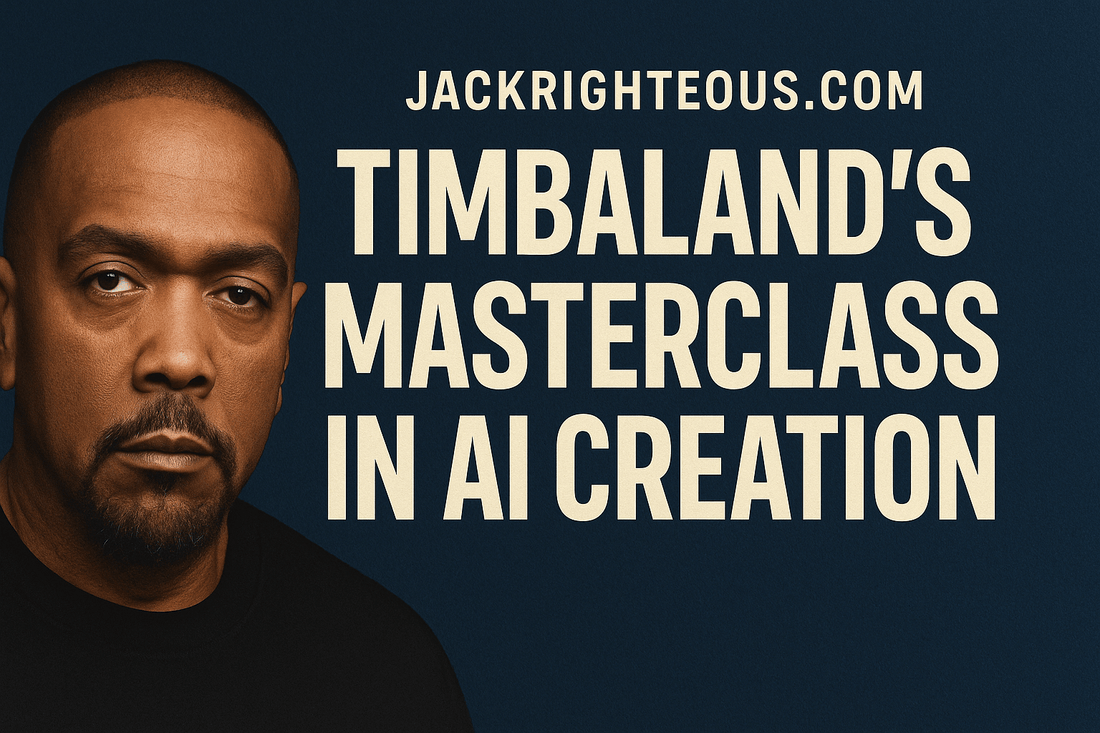
Timbaland, Suno, K Fresh and the Creator Rights Lesson AI Music Can't Ignore
Gary WhittakerThe biggest lesson from the Timbaland–K Fresh controversy is simpler than the arguments around AI training: having an audio file is not the same thing as having permission to upload, transform or publish every creative element inside it.
That distinction matters for anyone using Suno, Musicfy, ElevenLabs or another AI-assisted music workflow. A collaborator can send you a song. An artist can send you vocals. A rapper can send you a demo over somebody else’s beat. None of those situations automatically mean every contributor has cleared every downstream use.
This article focuses on that creator-rights lesson. For the broader story of Timbaland’s relationship with Suno, Stage Zero and TaTa Taktumi, read Timbaland + Suno: From AI Experiment to Artist Development (2024–2026).
What actually happened with K Fresh?
In June 2025, producer K Fresh said a beat he created had been used in a Suno demonstration associated with Timbaland without his permission. Reporting at the time described Timbaland uploading audio that contained K Fresh’s beat and producer tag into Suno and generating a new version from it.
K Fresh and attorney Ryan Schmidt later published an open letter demanding an apology and other safeguards. Timbaland responded publicly and said he believed the artist who sent him the song fully owned it. He acknowledged that K Fresh had not consented and apologized for failing to do the necessary due diligence.
The useful takeaway: this was not merely a debate about whether AI is good or bad. It exposed a chain-of-rights problem: one person possessed the file, but another contributor’s work was embedded inside it.
That distinction is also why I would not describe the incident as proof that uploading a song necessarily means it becomes “training data.” Public reporting frequently blended the upload/remix dispute with the much larger debate over how generative-AI companies train models. Those are related policy questions, but they are not the same factual claim.
Permission has layers
When creators say, “I have permission,” the next question should be: permission for what?
- Composition: Who controls the melody and lyrics?
- Sound recording: Who controls the actual master or demo recording?
- Beat or production: Was it licensed, purchased, leased, commissioned or borrowed?
- Vocals: Did the vocalist agree to AI-assisted transformation, cloning, conversion or model use?
- Samples: Are third-party recordings embedded in the file?
- Collaborators: Do co-writers and co-producers agree to the specific downstream use?
- Platform upload: Do you have the rights the platform requires you to have before uploading the material?
- Commercial release: Are the permissions broad enough for monetization, distribution and promotion?
A “yes” at one layer does not automatically answer the others.
The five-minute provenance check before you upload
Before putting collaborative audio into an AI music system, stop and document these five things:
- Where did this file come from? Record who sent it and when.
- Who created each major element? Identify the beat, lyrics, melody, vocals, samples and master.
- What did each person actually authorize? Do not substitute assumption for consent.
- Does the authorization include AI-assisted processing? If that use was never discussed, clarify it.
- Can you prove the chain later? Keep messages, agreements, licenses, receipts and source files.
This does not magically establish copyright ownership. It creates a clearer record of your process and makes it easier to identify a rights gap before the gap becomes a public problem.
What Suno's own upload safeguards tell creators
Suno has publicly described user uploads as a rights-sensitive part of its product. In October 2024, it announced an integration with Audible Magic for content identification in the upload process, saying the goal was to help prevent unauthorized uploads.
That safeguard is useful, but creators should not outsource their responsibility to a detection system. A platform may fail to recognize an uncleared beat, an unpublished demo, a collaborator’s vocal, a small sample or a private recording. “The platform accepted the upload” is not the same as “the rights are cleared.”
Read Suno’s Audible Magic announcement.
Why Timbaland's role makes the incident more important, not less
Timbaland’s relationship with Suno was already significant by the time the K Fresh dispute occurred. Suno had partnered with him in 2024, and Stage Zero launched in 2025 as a separate AI-focused entertainment venture with TaTa as its first announced AI artist. That made Timbaland one of the most visible mainstream producers experimenting publicly with AI-assisted music development.
The K Fresh incident therefore matters because it demonstrates that experience, status and access do not eliminate provenance risk. In fact, the more public the project, the more consequential a rights mistake can become.
Music Business Worldwide’s Stage Zero report documents the company’s launch and its separation from Suno.
A better rule for AI-assisted collaboration
Possession is not permission.
If you did not create every element in the file yourself, treat the file as collaborative material until you can identify who controls what and what uses have actually been authorized.
This rule works whether the next tool is generative AI, a sampler, a remix engine, a stem separator, a vocal converter or a traditional DAW. AI changes the speed and scale of transformation. It does not erase the underlying need to know where the material came from.
What creators should document now
If AI-assisted creation is part of your workflow, maintain a simple project record containing:
- original source files and dates;
- human-written lyrics and revisions;
- prompt and generation history where useful;
- licenses for beats, samples and third-party material;
- collaborator approvals;
- which platform and account produced the output;
- the subscription/commercial-use status that applied at the time;
- your human editing, arrangement, selection and production decisions.
Again, documentation is evidence of process, not an automatic certificate of ownership. But if a distributor, collaborator, platform or lawyer later asks what happened, a documented chain is far better than memory.
The creator-rights question is bigger than Suno
The same due-diligence problem follows creators across platforms. Different tools have different terms, commercial-use rules, voice policies and upload requirements. The durable skill is not memorizing one platform’s current interface. It is learning to ask:
What am I bringing into this system, who contributed to it, what am I asking the system to do with it, and do I have permission for that use?
That is the rights habit worth building.
Go deeper — free
Map the rights before you release.
If the difficult part is figuring out permission, ownership, platform terms and what records to keep, continue with the free AI Music Rights & Ownership Guide 2026.
Build the full creator system
Rights clarity works best when it is connected to how you make, publish, own and operate your work. The free Creator Academy organizes that journey from Sound to Voice to Brand to Operate & Grow.
Editorial note: This article discusses practical creator-rights workflow and publicly reported events. It is educational information, not individualized legal advice. Updated August 19, 2026.

4 Kommentare
🔒 Statement on Free Speech, AI Extremism, and Threats
I’m a strong supporter of free speech — including disagreement. Civil debate is welcome here. But threats, bullying, and intimidation are not.
When it comes to anti-AI extremism, I need to be even clearer: there is no conversation to be had with those who think threatening people is justified. To make that point visible, I’ve left some of the threats posted — the rest will be removed unless they offer actual value to the discussion.
Yes, there are real risks with AI. Some credible PhDs believe we may have already crossed a line we can’t reverse — something I plan to explore in future posts. That matters. But attacking individual creators or AI proponents is misguided. AI is being deployed at massive scale by governments and corporations. Targeting individuals solves nothing.
If you’re making threats because you think you’re saving the world — you’ve lost your way. And I say that as someone who has been in dark places, too. You’re not unique. You’re not alone. But you are wrong.
You think you’re crazy? So am I. So are all of us when pushed hard enough. That doesn’t make you special — it just means you’re human.
And if you’re threatening others, it’s time to stop and get help. Not just for them — but for yourself.
— Jack Righteous
All hail Jack Righteous, Troll of the Gods, King of Fuck-All, Emperor of Knock-It-Down & Break-Everything, and Archbishop of Screw-All-Of-You!
Either you don’t get it, or you don’t care. Neither are acceptable.
“BUILD BOLD. BE RIGHTEOUS. LEAD WITH YOUR LEGACY.”
GET YOUR HEAD OUT OF YOUR ASS!